
AI Takes Aim at Mars: A Student's Vision Decodes the Red Planet's Ancient Scars
By Bao Ge · August 24, 2026 · 3 min read · 👁 0 views

In a quiet corner of YCIS Chongqing, a young researcher has just reimagined how humanity explores another world. Declan Dumbrill, a student with a passion for both code and cosmology, has engineered a sophisticated three-stage AI system, not merely to spot craters on Mars, but to make them speak.
The system does more than scan. It sees. It interprets. It reveals.
The first two stages operate with fierce independence, a sandboxed AI architecture that runs entirely offline, untethered from the cloud, digesting vast satellite imagery with nothing but its own algorithms for company. No internet. No external crutches. Just raw computational intelligence dissecting the Martian surface pixel by pixel.
Then comes the third act: a large language model that steps in not for image analysis, but for geographical reasoning. And it delivers a staggering verdict, the terrain it studied is ancient, somewhere between 3.7 and 4.0 billion years old, a frozen whisper from the dawn of the solar system.
But the real revelation? Speed.
When put to the test on a Martian region, Dumbrill's system correctly identified the overwhelming majority of known craters, and it did so in just 12 minutes. That same painstaking work would consume a human researcher weeks for a single map tile, or years to canvas the entire planet. Scaled up, this student-built AI could survey the whole of Mars in roughly three weeks, all running on a single laptop.
This isn't just automation. It's acceleration. It's the kind of planetary reconnaissance that was once the stuff of science fiction, now made tangible by a student's ingenuity. Dumbrill's work proves that carefully engineered AI can now shoulder the burden of preliminary planetary surveys, freeing human scientists to ask deeper questions while machines handle the heavy lifting.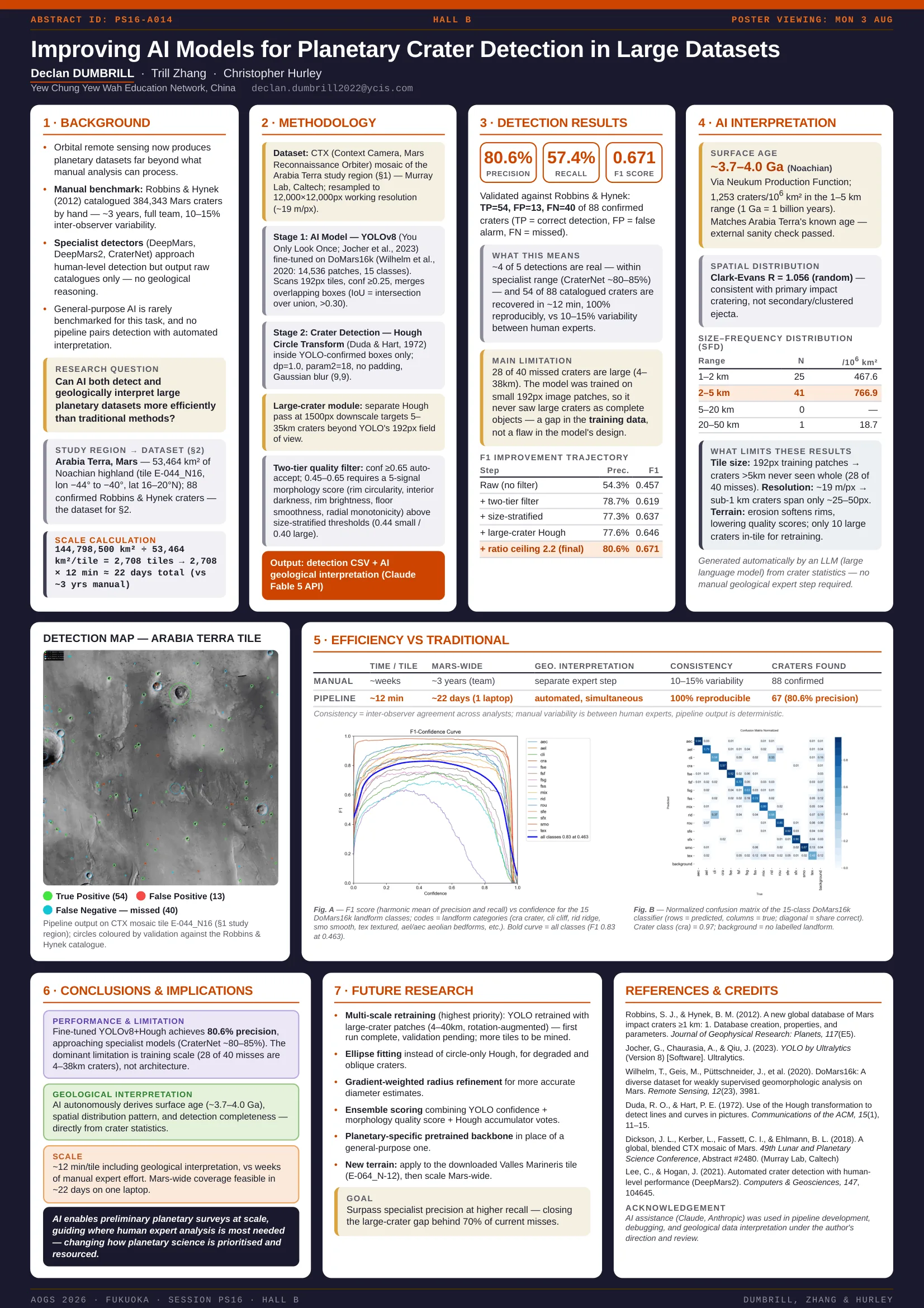
From Chongqing to the Global Stage
On August 2-7, that ingenuity took Dumbrill far beyond the classroom. He boarded a plane for Fukuoka, Japan, not as a tourist, but as an invited speaker at the 23rd Annual Meeting of the Asia Oceania Geosciences Society (AOGS) , one of the most prestigious international conferences in the Earth and planetary sciences.
There, surrounded by distinguished professors, veteran researchers, and emerging scientists from every corner of the globe, Dumbrill stepped up to the podium. He delivered a full English oral presentation in the Planetary Science session, and he didn't just hold his own. He commanded the room.
As one of the youngest speakers in the entire conference, he stood before scholars who had spent decades in the field, sharing his research with clarity, confidence, and conviction. The response? Genuine professional recognition. Esteemed academics took notice. Questions flew. Conversations ignited. A high schooler from Chongqing was no longer just a student, he was a peer in the global scientific community.
This is what it looks like when education transcends textbooks. From a classroom in China to an international podium in Japan, Dumbrill's journey is not merely about a brilliant presentation. It is about courage, the courage to voice bold ideas, to explore the unknown, and to engage in dialogue with the world's brightest minds.
True international education isn't measured by passport stamps or overseas campuses. It is measured by a single, defining moment: when a young person steps onto a global stage, looks the world in the eye, and speaks. Declan Dumbrill did exactly that.
One laptop. Two billion years of history. A student who dared to share his vision with the planet. And a future where the Red Planet's secrets may no longer stay buried for long.
All images courtesy of YCYW EdFutures Programme
Keep reading
All in Articles
Legend Levels Up: Shekou's Beloved Hangout Reinvents Itself as a Sports Bar & Grill
Some bars are places you go. Legend is a place you return to. For six years, this Shekou staple has anchored the corner of Nanhai Yiku, pouring...

Free Sky Observation Deck: Shenzhen's Window to the Clouds at 547.6 Meters
High above the pulsating heart of Shenzhen, the Free Sky Observation Deck commands the 116th floor of the Ping An Finance Center at a...

China's New Kind of Pet Remembers Your Conversations, Never Needs a Vet, and Doesn't Pee on the Carpet
I once wrote about dogs in strollers in China, and after that I stopped being surprised by what comes rolling towards me in a shopping mall. Baby,...