
Inside Shenzhen's Robotaxi Revolution: Where Algorithms Drive & Humans Pivot to Livestream
By Chris Gassner · July 29, 2026 · 6 min read · 👁 0 views
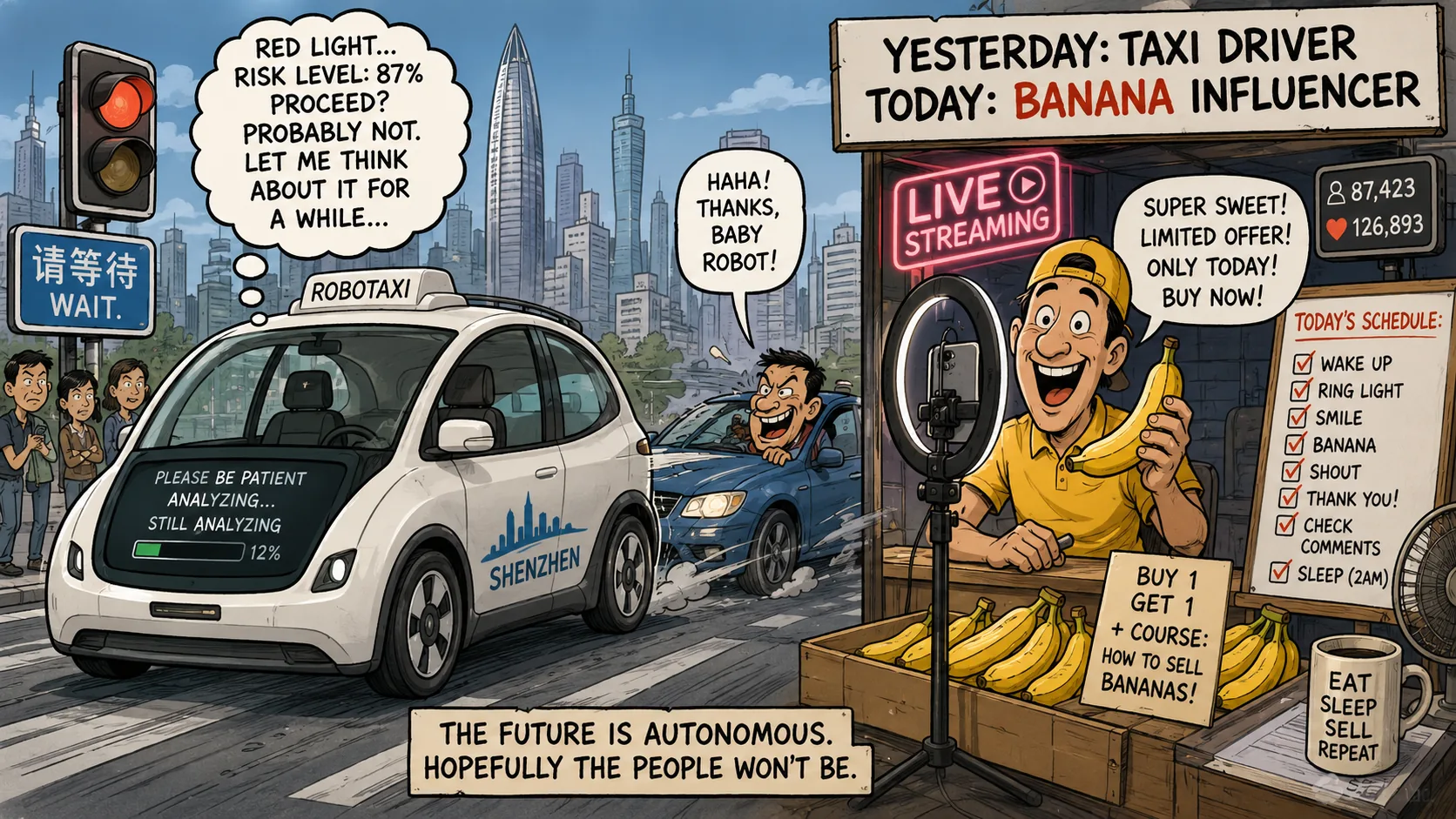
The other day, I got into a taxi in Shenzhen and noticed after a few seconds that the driver was unusually quiet. Then I realised there was no driver at all. That at least explained why he was neither shouting into his phone nor trying to sell me an apartment in Huizhou.
The driver’s seat was empty, the steering wheel moved by itself, and a friendly voice informed me that the journey was about to begin. It sounded calm, competent, and entirely free of that personal disappointment human drivers sometimes display when they discover that your destination is only six kilometres away.
The robotaxi set off.
It drives carefully. Sometimes so carefully that it behaves like a toddler with a driving licence. It knows every rule, keeps its distance, waits patiently, and assumes the other road users will behave as well. A touching mistake.
The human drivers, of course, spot this weakness immediately. They cut in, squeeze in front, steal every gap and treat it much like older children treat the new kid in the playground who still believes in fairness. The robotaxi brakes, analyses, and waits. It moves with the measured determination of people carrying a refrigerator through a narrow stairwell. Progress is made. Centimetre by centimetre, with intense concentration and no sudden movements whatsoever.
You reach your destination safely. Occasionally in a later stage of life. On some routes, you would have been faster on foot, assuming you were wearing sensible shoes and did not age too much along the way.
Still, these vehicles are no longer some technological fairground attraction. Fully driverless commercial services already exist, and the latest generation of robotaxis is beginning to reach the point where it is no longer merely functional, but economically viable. The future is no longer driving around in circles for demonstration purposes. It is beginning to make money.
And that is where things become interesting.
Because while the taxi moves independently through Shenzhen, one question remains sitting on the back seat: what happens to the man who used to sit in the front?
The modern economy has an entire cupboard full of reassuring words for this. Nobody loses a job anymore. People are transformed, released, developed, reskilled, or prepared for higher value work. Unemployment appears to have vanished. Human Resources simply renamed it.
The former driver could reinvent himself. He could attend a course, enter the digital economy, or build his personal brand. Perhaps he becomes an influencer.
Yesterday, he transported people through Shenzhen. Today, he sits in front of a ring light holding a banana up to the camera as if retirement planning had finally grown a peel.
This banana, he explains with a level of enthusiasm that is hopefully regulated by contract, is exceptionally sweet. Today only, it costs 19.90 yuan. Anyone ordering immediately receives a second banana, a discount code, and possibly an online course explaining how to become successful at selling bananas.
This is not even entirely absurd. China has an enormous digital sales economy. Livestream commerce is no longer a strange pastime for people with ring lights. It is an established way of selling things.
That does not mean every person whose former job has been taken over by a machine can now earn a living by holding products in front of a camera.
How many former taxi drivers, factory workers, cashiers, and delivery riders can sell bananas at the same time before the number of sellers exceeds the number of people still buying bananas?
A society cannot consist entirely of people recommending products to one another. Someone still has to manufacture, transport, and pay for those products. If everyone becomes an influencer, there will be nobody left to influence. Eight million people will sit in front of eight million ring lights, explaining to one another why this electric garlic press is going to change their lives.
Of course, some people earn a great deal of money from livestreaming. Some people also win the lottery. Nobody would seriously suggest replacing unemployment insurance with a scratch card machine.
The new labour market also demands more than simply being good at something. People are now expected to sell themselves while doing it.
In the past, a taxi driver had to drive safely, know the city, and turn up reliably. Today, he would also need to look good on camera, speak entertainingly, produce new content every day, respond to comments, sell products, and keep the algorithm in a pleasant mood. By nine in the morning, he must already possess enough excitement to hold an electric vegetable slicer into the camera as if fire had just been discovered.
Perhaps he does not want to.
Perhaps he does not want to become a personal brand. Perhaps he simply wants to work, earn money, and go home afterwards. In the age of permanent self promotion, that almost sounds suspiciously lacking in ambition.
At least one other question has been answered rather soberly: who is responsible when nobody was driving? If a highly or fully automated vehicle causes an accident while the automated system is active, responsibility falls on the owner or operator where the fault lies with the vehicle.
The car itself does not receive a traffic ticket and does not have to explain to its wife in the evening why it has driven through another red light. The operator pays. The machine remains emotionally unharmed, charges its battery, and begins its next shift punctually the following morning.
The human being, by contrast, suffers from several unfortunate design flaws. He needs sleep, food, housing, and occasionally even money. Some drivers also support children or elderly parents, which is difficult to present elegantly in an investor presentation.
Hundreds of thousands of taxi and ride hailing drivers work in Shenzhen. Many are already dealing with long days, falling income, and an overcrowded market. Some originally came to the city as factory workers and later moved into driving after industrial jobs became less secure. Automation is now following them through their employment history. First, it met them on the production line. Now it is waiting outside at the taxi rank.
Naturally, we customers are not innocent either.
We complain about the disappearance of secure jobs and then select the cheaper vehicle in the app. We worry about the working conditions of delivery riders and still order a single bottle of water at 11:40 at night because delivery is free.
The customer is not a bad person. He is simply a person with an app, a discount code, and an astonishingly short memory for his own social convictions. Our concern usually lasts until the screen informs us that the driverless option is eight yuan cheaper.
Meanwhile, my robotaxi continues its cautious approach to the destination. Once again, a human driver forces his way in front. The autonomous vehicle brakes obediently and lets him through.
Perhaps the man in that car is exactly the person whose job this vehicle will one day replace. Today, he still takes every gap the machine allows him. Tomorrow, he may be sitting in a livestream explaining why his bananas are better than those sold by three thousand other former taxi drivers.
The robotaxi will come. It will probably become faster, more skilful, and less easily intimidated. Perhaps one day it will learn to behave as ruthlessly in traffic as we do and will then finally be considered fully mature.
But not every person whose job disappears can simply launch his own television channel. An economy cannot survive by having everyone sell one another bananas, vegetable slicers, and courses about selling bananas and vegetable slicers.
The future may no longer need drivers.
But it cannot possibly consist only of followers.
Chris Gassner
Keep reading
All in Articles
Legend Levels Up: Shekou's Beloved Hangout Reinvents Itself as a Sports Bar & Grill
Some bars are places you go. Legend is a place you return to. For six years, this Shekou staple has anchored the corner of Nanhai Yiku, pouring...
Free Sky Observation Deck: Shenzhen's Window to the Clouds at 547.6 Meters
High above the pulsating heart of Shenzhen, the Free Sky Observation Deck commands the 116th floor of the Ping An Finance Center at a...
China's New Kind of Pet Remembers Your Conversations, Never Needs a Vet, and Doesn't Pee on the Carpet
I once wrote about dogs in strollers in China, and after that I stopped being surprised by what comes rolling towards me in a shopping mall. Baby,...