
November 11: The Longest Day of the Year
By Chris Gassner · November 4, 2026 · 6 min read · 👁 0 views
Some holidays have the decency to stick to the calendar. Christmas is on December 24, at least for us Germans. Americans wait until the 25th, presumably because they need an extra night to find the presents. Easter moves around a little, but at least it follows the moon, and the moon has been reasonably reliable for the past few billion years.
And then there's November 11.
In Germany, Carnival season begins on November 11 at precisely 11:11 a.m. It's wonderfully German. At 11:10 you're still wearing a tie. By 11:12 you've got a red clown nose. In China, November 11 is Singles' Day, also known as Double 11, and apparently it starts whenever it feels like it. This year, for example, on October 12.
I discovered this on an ordinary Monday evening when my phone proudly announced that Double 11 had begun. I checked the date. Twice. Then I wondered whether my phone had somehow switched to a time zone where it was already November. It hadn't. JD.com had simply launched its sale at 8 p.m., with everything immediately available. Apparently, they didn't want the competition getting there first.
Too late. Kuaishou had started on October 7 and planned to keep going for forty days. Forty days! That's how long Jesus fasted in the wilderness. Kuaishou made a few adjustments. Instead of fasting, there's shopping. Instead of the wilderness, a shopping cart. And instead of the devil, hourly discount offers. Other platforms joined in throughout October, with sales running until November 15. So this year, November 11 ends four days after November 11. I've given up trying to understand the logic. It's like starting New Year's Eve in October and keeping it going until January because a few people still haven't finished their fireworks.
Once upon a time, Singles' Day was rather innocent. In the early 1990s, students in Nanjing decided to celebrate being single. They chose November 11 because the four ones looked like four lonely people standing around. Rather touching, really. Then, in 2009, Alibaba discovered that loneliness becomes more bearable when you buy yourself a present, and turned it into a shopping event. One day, mind you. Twenty-four hours.
It has since become the longest day of the year. Last year's event lasted five weeks and generated 1.695 trillion yuan in sales. I tried to imagine that amount of money and fell asleep somewhere among the zeros.
My favourite part of Singles' Day was always the mathematics. For years, the sacred principle was simple: spend 300 yuan, save 50. Except it wasn't simple. You had to combine products from different shops, collect vouchers, pay deposits and remember which coupon worked with which other coupon. Buying a television required considerable mathematical ability and even greater patience.
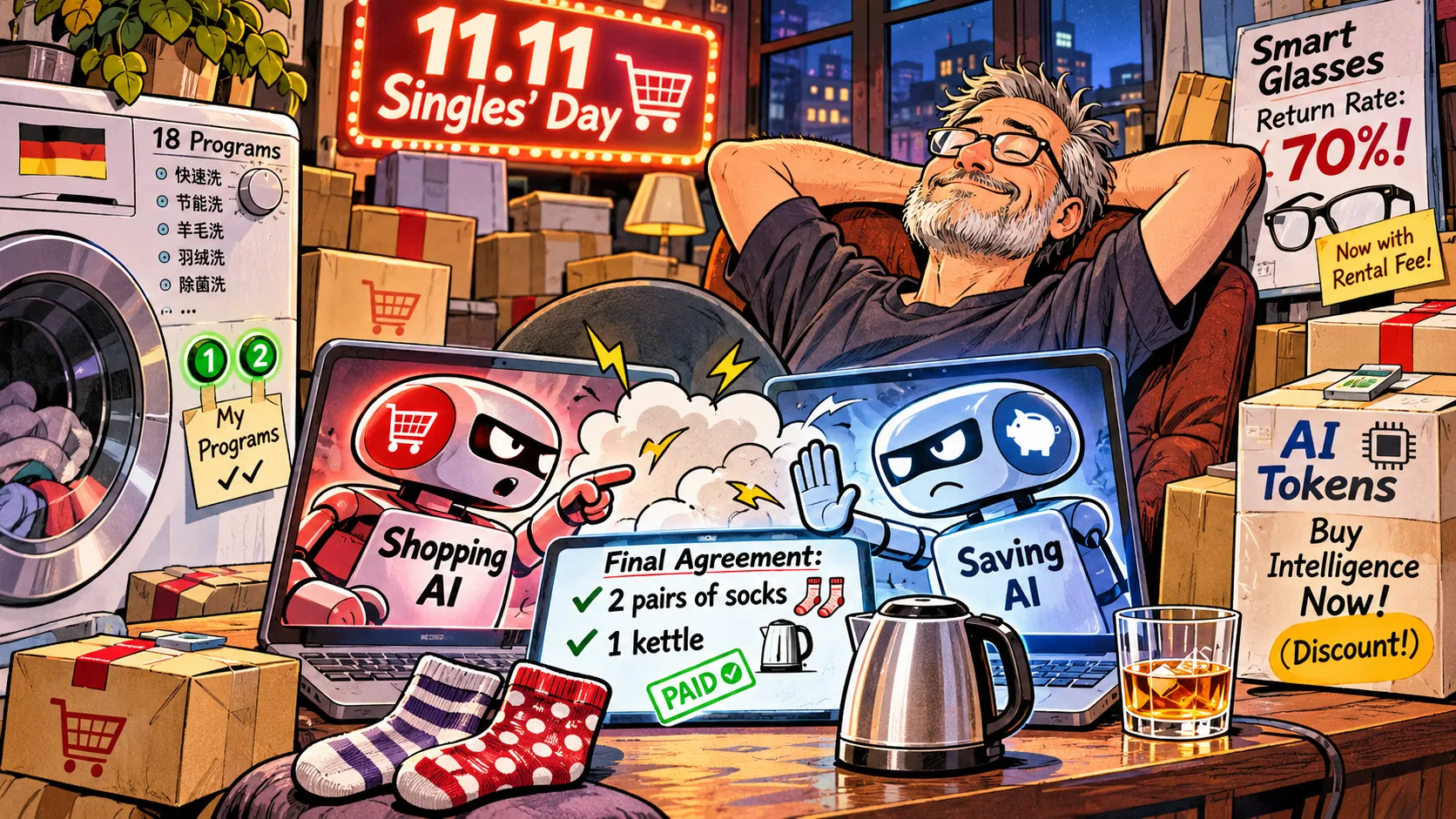
People bought a pair of socks to make their television 50 yuan cheaper, then returned the socks a week later. The socks were never intended to be worn. They had one job: make the television cheaper. Mission accomplished, they were sent back. Probably without even being thanked.
Those days are over. This year, the major platforms have scrapped the complicated cross-store discount system. Instead, discounts are applied directly to individual products. No coupons, no combinations, no calculator. Apparently, someone finally noticed that people were buying things they didn't need just to qualify for discounts, then returning them.
It took the industry seventeen years to realise that a discount shouldn't require customers to buy three things they don't need just to save money on the one thing they actually want. A remarkable breakthrough. German supermarkets figured that out decades ago. They simply put a red price tag on it.
Retailers are also being stopped from raising prices in September just to announce spectacular discounts in November. Platforms now check price histories and offer price protection. Until recently, raising prices by thirty percent and then proudly offering twenty percent off was considered a bargain. At least by the people selling it.
While retailers are busy sorting out their discounts, customers have found another way to beat the system. More than sixty percent of young people reportedly use AI to help them shop.
Some have even started asking AI what they shouldn't buy in the first place. Three questions for every product...: Have you used something like this recently? Do you already own one? What happens if you don't buy it? Two unnecessary answers, and out it goes.
An entire industry spends billions developing algorithms to persuade people to buy things. And people respond by getting another algorithm to talk them out of it. A digital marriage at war, with one partner constantly dragging new purchases into the house while the other demands to know where they're supposed to put them.
Eventually, the two programs will probably negotiate directly. The shopping AI orders a television. The saving AI cancels it. The shopping AI offers a voucher. The saving AI points out that we already own two televisions. Then things get personal. The shopping AI accuses the saving AI of having no sense of fun. The saving AI produces the bank statements.
After four hours of increasingly hostile negotiations, they settle on two pairs of socks and a kettle. The saving AI agrees to the purchase and pays for it, because by now it knows its owner well enough to realise that a completely empty shopping cart would only cause another argument.
On November 16, we receive a notification informing us what we've bought. Everything has already been delivered and paid for. The user is happy. The algorithms have made peace. Until next year.
Just how useful such a list might be becomes clear when you look at smart glasses. For some models, return rates reportedly reached seventy percent. Seventy percent! If seven out of every ten pairs came back, I'd stop selling glasses altogether and start charging a rental fee. At least then the manufacturer would earn something from people trying them on.
My washing machine has eighteen programs. I use two. The rest remain a mystery because everything is written in Chinese. And this is a German washing machine! Apparently, it surrendered its native language upon entering China. What those two programs actually do, I haven't the faintest idea. I pressed them by accident one day, the laundry came out clean, and I've refused to touch anything else ever since. Never interfere with a functioning system.
My personal favourite, however, is something else entirely. You can now buy AI computing power on Tmall. Tokens, sometimes even at a Singles' Day discount. We've finally reached the point where intelligence comes in prepaid packages. Run out of tokens, run out of thinking. Humanity has managed to put thinking on special offer. I wonder if common sense is available too.
I actually tried the do-not-buy list myself. My shopping cart contained razor blades, an extension cable and a bottle of whisky. The saving AI immediately rejected the razor blades because I have a beard. The cable went too, because I apparently already own four, all lying somewhere in a drawer, quietly tying themselves into knots.
The whisky, however, passed the question about how often I'd used something similar during the past thirty days with flying colours.
The AI was apparently impressed.
So was I.
In the end, Singles' Day has remained remarkably faithful to its origins. It's still a celebration for people who enjoy being alone. You stay at home for five weeks, meet nobody and speak to no one.
And yet someone still comes to visit every single day.
The delivery driver.
Chris Gassner
Keep reading
All in Articles
Ways of Seeing Exhibition: Eight Artists. Eight Perspectives. Endless Ways of Seeing the World
Have you ever wondered how differently we all see the same world? We walk through the same streets, share the same spaces, and experience the same...
Veta Chang: Where Art Meets the Soul
" Ink as altar, needle as pen, lines are prayers that never end. Straight or winding, thin or deep, they carve the promises the soul...
The Overuse of Clinical Terms in Our Daily Conversations
Anxiety and depression: two words we use in our conversations as if they were an essential part of the sentence structure. I get it. In a world of...