
Shenzhen: A City Where Reality & Performance Blur Beneath Ring Lights & Smartphones
By Chris Gassner · July 7, 2026 · 5 min read · 👁 0 views
Smile, Please, China Is Live.
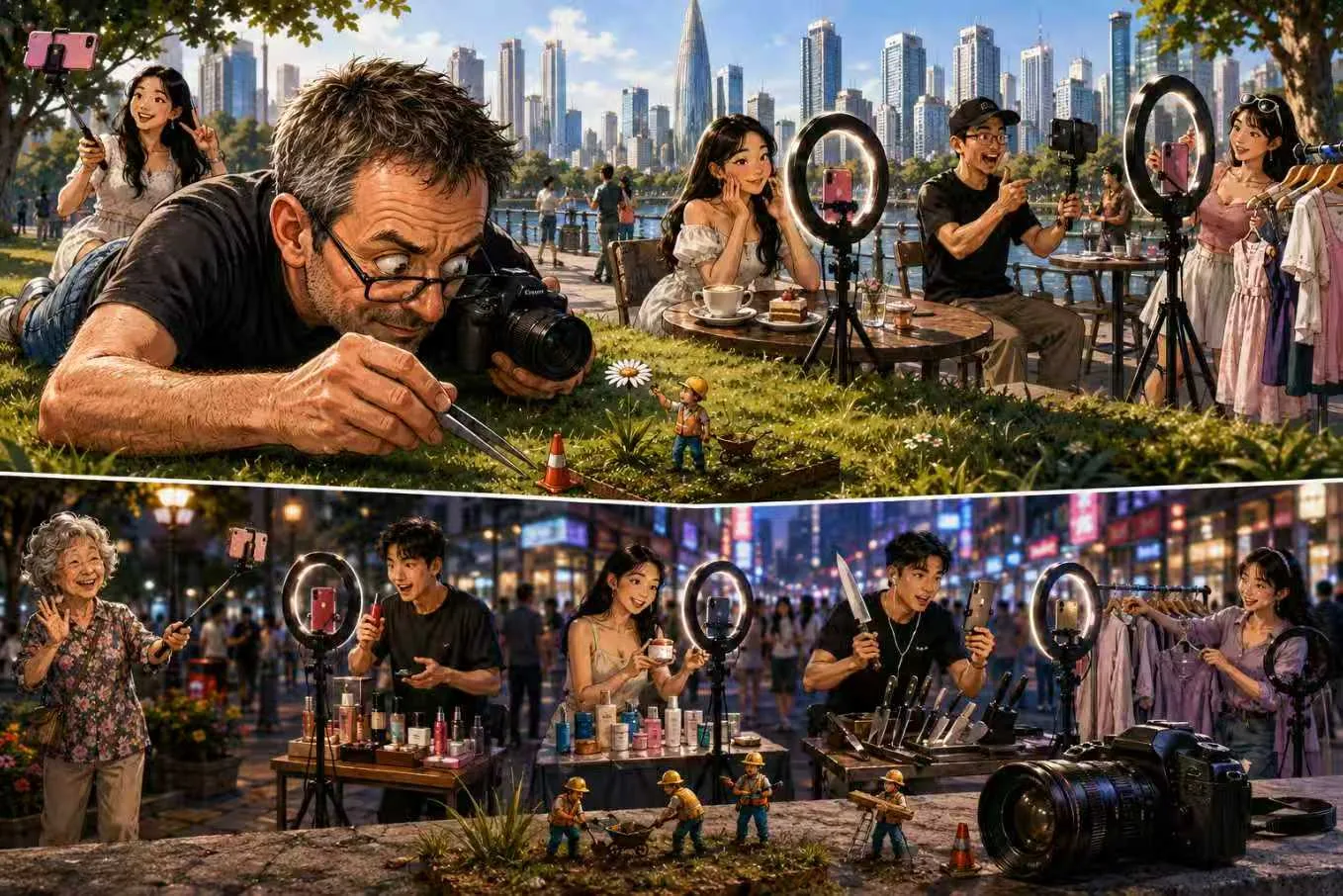
It all started with a blade of grass.
Not just any blade of grass. The one blade of grass that stubbornly refused to stand exactly where I wanted it.
So I nudged it three millimetres to the left.
Then I moved a tiny construction worker half a centimetre to the right.
One step back.
Camera up. Camera down. No. The angle still wasn’t right.
At that exact moment, two friends walked past. They looked at me, smiled, shook their heads and simply kept walking.
I am fairly sure they were thinking exactly what I would have thought just a few weeks earlier:
He has finally lost it.
After fifteen years, I had finally bought myself a new camera. My plan was simple: learn photography.
Somehow, I ended up negotiating with grass.
The funny thing is, not long ago I used to laugh at people doing exactly that kind of thing.
In Shekou, my little Gallic village inside the gigantic organism called Shenzhen, you see them everywhere. Young women posing in front of cafés, men with microphones, ring lights, tripods, phones, backup phones, emergency backup phones. Hair adjusted. Jacket adjusted. Chin slightly higher. No, slightly lower. Smile. Again. One more. Now turn. Now pretend this was all completely spontaneous.
I used to walk past and think: how much effort can one human being invest into three seconds of video?
Today I spend half an hour wondering whether a daisy should be on the left or right side of a two-centimetre construction worker.
Humility comes fast when karma has good lighting.
The more I played with my camera, the less I photographed buildings, skylines or sunsets.
Instead, I started photographing people.
People photographing people. People filming people.
People filming people who were photographing other people.
At some point I completely lost track of who was the photographer and who was the attraction.
China is probably the only country where I genuinely wonder whether I am walking through a city, or accidentally through someone else’s shot.
Of course, influencers exist everywhere. Germany has them. America has them. Every country with Wi-Fi and self-confidence has them.
But China has a special talent for turning a trend into a team sport.
And with more than 1.4 billion people, that team can become rather impressive.
Sit down in a café and watch. The cappuccino arrives. Nobody drinks. First, the cup must be rotated.
The spoon moves two centimetres to the left. The napkin is folded. The hand enters the frame.
“No, wait, the light is not good. ”Click. Another one.Click. Now a short video.
By the time the cappuccino is finally allowed to fulfil its original purpose, it has roughly the temperature of the air-conditioning.
Restaurants are no better.
Twelve dishes arrive.
Twelve people reach for their phones.
The table suddenly looks like an archaeological discovery being documented from every possible angle.
Only after every dish has completed its media appearance may the actual eating begin.
I strongly suspect some meals in China spend more time in front of a camera than inside a stomach.
But the real theatre starts outside. In the evening, Shenzhen becomes a forest of ring lights.
On one corner, someone is selling lipstick.
Ten metres away, a woman is explaining the life-changing power of face cream.
Next to her, someone is demonstrating kitchen knives with the intensity of a surgeon.
Across the street, another livestreamer is talking about health supplements as if national security depended on it.
I now automatically walk around ring lights. Not out of politeness.
I just do not want to end up in the background of a livestream in Harbin, Chongqing or Kunming while someone is selling anti-ageing serum.
Recently, I stood outside a car showroom and watched a young presenter sitting in the driver’s seat of a new car. In front of her were more phones, screens and monitors than I have probably owned in my entire life. Two phones were streaming. One showed the live chat. A tablet displayed product information.
Another screen showed the camera angle. She was not talking to the people in the showroom.
She was talking to thousands of people somewhere out there. The real showroom was no longer the building. It was the internet. And this is the part where it stops being funny and becomes fascinating.
Because this is not just a few young people playing with phones.
Livestreaming in China is an industry. Behind many successful creators are entire companies, studios, teams, scripts, lighting setups, product managers and sales targets. Some rooms are not rented to live in. They are rented to look like someone lives in them.
A fake living room. A fake kitchen. A fake luxury office. Nobody sleeps there.
Nobody cooks there. Nobody works there.
But someone will sell toothpaste there at eight o’clock tonight.
And then, just when I was ready to feel very superior about all of this, a student walked past me.
I had just spent twenty minutes trying to photograph one of my miniature scenes.
Focus checked. Light adjusted. Angle corrected. Grass negotiated.
She lifted her smartphone. Click. Click. Click.
She looked at the screen once and walked away.
I never saw her pictures. But I am still convinced all three were better than mine.
Maybe it is not about the camera.
Maybe a generation that has been photographing, filming, editing and posting since childhood simply sees images differently. Composition is no longer something they learn in a course. It is daily life.
And that is when I had to laugh at myself.
A few weeks ago, I thought influencers were slightly ridiculous.
Today I spend thirty minutes improving the shadow of a tiny plastic worker.
I kneel in the park. I wait for the wind to stop. I move a blade of grass.
And if the light is wrong, I come back tomorrow.
The only difference is: I do not stream it.
At least not yet.
Maybe this is not really a column about China.
Maybe it is a column about how quickly we lose the right to laugh at other people.
China often shows developments earlier, bigger and louder than other places. What looks exaggerated here today may quietly become normal somewhere else tomorrow.
That evening, I came home, put the camera on the table and looked through the photos.
Then I thought about that blade of grass again.
A few weeks earlier, I would have laughed at someone moving it three millimetres to the left.
Now I understood.
Sometimes, those three millimetres make all the difference.
And sometimes, while trying to photograph the story, you suddenly realise you have become part of it.
Chris Gassner
Keep reading
All in Articles
Legend Levels Up: Shekou's Beloved Hangout Reinvents Itself as a Sports Bar & Grill
Some bars are places you go. Legend is a place you return to. For six years, this Shekou staple has anchored the corner of Nanhai Yiku, pouring...
Free Sky Observation Deck: Shenzhen's Window to the Clouds at 547.6 Meters
High above the pulsating heart of Shenzhen, the Free Sky Observation Deck commands the 116th floor of the Ping An Finance Center at a...

China's New Kind of Pet Remembers Your Conversations, Never Needs a Vet, and Doesn't Pee on the Carpet
I once wrote about dogs in strollers in China, and after that I stopped being surprised by what comes rolling towards me in a shopping mall. Baby,...