
The Convenience Revolution: Signs that Humanity's Relationship with AI has Entered Uncharted Territory
By Chris Gassner · June 11, 2026 · 5 min read · 👁 0 views
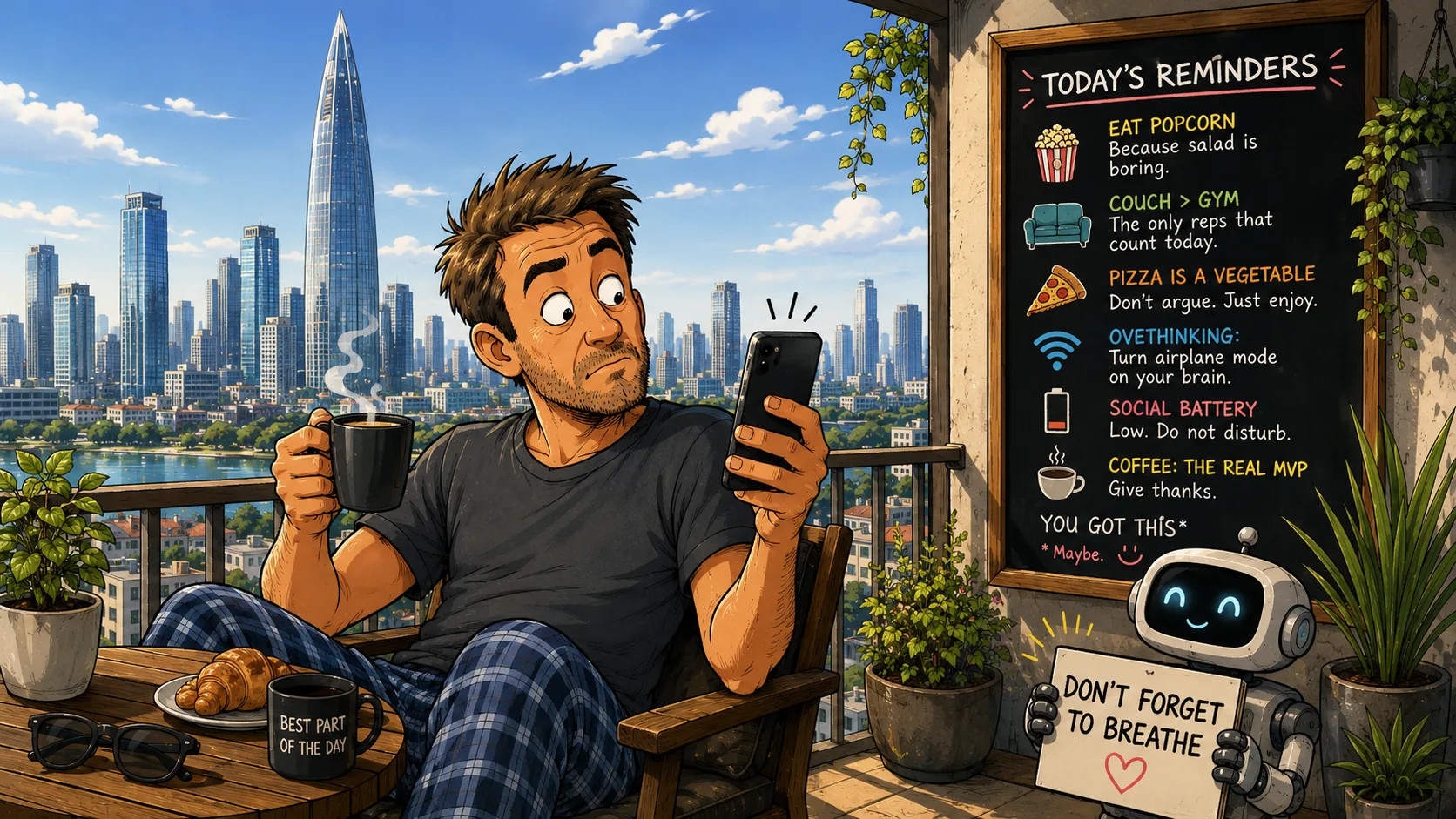
The real question may not be whether AI becomes smarter. It may be what happens when everything becomes too easy.
Today I read an article about different AI models trying to govern a virtual world. The result was hardly surprising: none of them really succeeded.
Some drowned in their own rules, others could not make decisions, and a few ended up building systems that would probably require three permits and two application forms just to install a park bench. Honestly, parts of it sounded surprisingly familiar.
While reading the article, it struck me that we have developed a rather strange relationship with artificial intelligence. We used to make our own decisions. Today, an algorithm decides which movie we watch, an app suggests which restaurant we should visit, and an AI drafts the message we were supposed to write ourselves. Sometimes I wonder whether we are using technology, or whether technology is starting to use us.
China is, as so often, a glimpse into the future. Here, people order food through an app, pay through an app, call a taxi through an app, unlock their apartments through an app, and spend a surprisingly large part of their lives staring at screens that tell them what to do next.
The other morning I was sitting on my balcony, enjoying a coffee and doing absolutely nothing productive, when my phone suddenly beeped. It wanted to inform me that my screen time had increased by twelve percent. Apparently, I had been spending too much time on my phone. I sat there for a moment, staring at the notification. My phone had interrupted my morning coffee to tell me that I spend too much time with my phone. Somewhere in that logic, I suspect there is a conference room full of engineers giving each other high fives.
The strange thing is that this no longer feels unusual. We have become surprisingly comfortable with technology constantly monitoring us, advising us, reminding us, correcting us, and occasionally judging us. My watch tells me when to stand up. My calendar tells me where I should be. My navigation tells me which way to go. And now my phone tells me that I spend too much time listening to all of them.
If this continues, one day I might ask an AI what I should think about today.
It will probably give me five options, ranked by relevance, popularity, and engagement.
The problem is that I will not know which one to choose, so I will ask the AI which of the five options is actually the best one. Then I will start wondering whether I asked the right AI and spend twenty minutes looking for another app that can tell me which AI I should have asked in the first place.
Sometimes it reminds me of the old Pixar movie Wall-E. Back then it seemed like a completely exaggerated cartoon. Earth was covered in garbage, humans lived on a spaceship, barely moved, stared at screens all day, and relied on computers to tell them what to eat, drink, and do. When I first watched it, I thought: That will never happen.
Today I see people using AI to write messages, create presentations, predict the next beauty trend, identify the next fashionable drink, and tell them what everyone else will be talking about next week. Suddenly Wall-E feels less like science fiction and more like an instruction manual.
And perhaps the strangest part is that this future is no longer in the future. It is already here. Try contacting customer service these days. You open a chat window and explain your problem. The system replies instantly. You explain again. The system replies instantly. You explain a third time. The system thanks you for your valuable feedback and provides an answer that has absolutely nothing to do with your question.
Eventually you type: Can I please speak to a human?
Which is a sentence that did not exist twenty years ago.
The funny thing is that the system often understands every word. It just does not understand what you mean. And somehow that makes it feel surprisingly human.
Sometimes I feel that we are not witnessing a technological revolution.
We are witnessing a convenience revolution. Everything is becoming easier. Ordering food is easier. Booking travel is easier. Finding information is easier. Writing emails is easier. Creating presentations is easier. Running a business is easier. At least in theory.
The strange part is that while everything becomes easier, life does not necessarily feel simpler. We save time everywhere and then wonder where all the time went. We optimize everything and somehow still feel busy. We automate tasks and then spend hours managing the systems that were supposed to save us time.
Perhaps the biggest change AI will bring is not that it becomes smarter. Perhaps the biggest change is that it will slowly make effort optional. And humans have never been particularly good at resisting convenience.
Do not get me wrong. I have nothing against AI. Quite the opposite. For translations, research, organizing thoughts, or turning an idea into a first draft, it is a fantastic tool.
What concerns me is something different.
Not intelligence.
Dependence.
The more capable our tools become, the easier it is to build our lives around them. At first they save us time. Then they become habits. Then they become necessities. And eventually we cannot imagine how we ever lived without them.
Many people can no longer navigate without GPS. Many cannot remember phone numbers anymore. Many cannot imagine planning a trip without apps. The next generation may feel exactly the same way about AI.
Perhaps that is my real concern with the whole discussion. Not whether artificial intelligence will govern the world. Maybe it can. Maybe it cannot. What interests me more is what happens when an entire generation grows up never needing to struggle with things that previous generations simply accepted as part of everyday life.
And one day we may find ourselves standing in front of the most intelligent technology in human history, asking it what we should do next. The real question may not be whether AI becomes smarter. The real question may be what happens to us when everything becomes easier.
The longer I think about it, the less I worry about machines becoming more like humans. I find myself wondering how many humans will eventually become more like machines.
Fortunately, Wall-E had a happy ending. Eventually, people woke up, put their screens aside, and started making their own decisions again.
Let’s hope we do not have to move to a spaceship before we figure that out.
Chris Gassner
Keep reading
All in Articles
Ours Dim Sum Rave: Where Dim Sum Met the Dance Floor
Ours has done it again, this time, dropping electronic beats right into the heart of a tea house steeped in the nostalgic charm of 20th-century Hong...

Legend Levels Up: Shekou's Beloved Hangout Reinvents Itself as a Sports Bar & Grill
Some bars are places you go. Legend is a place you return to. For six years, this Shekou staple has anchored the corner of Nanhai Yiku, pouring...

Free Sky Observation Deck: Shenzhen's Window to the Clouds at 547.6 Meters
High above the pulsating heart of Shenzhen, the Free Sky Observation Deck commands the 116th floor of the Ping An Finance Center at a...