
The Kinder Surprise Paradox: How Shenzhen Turned Feelings into a Growth Market
By Chris Gassner · August 17, 2026 · 7 min read · 👁 0 views
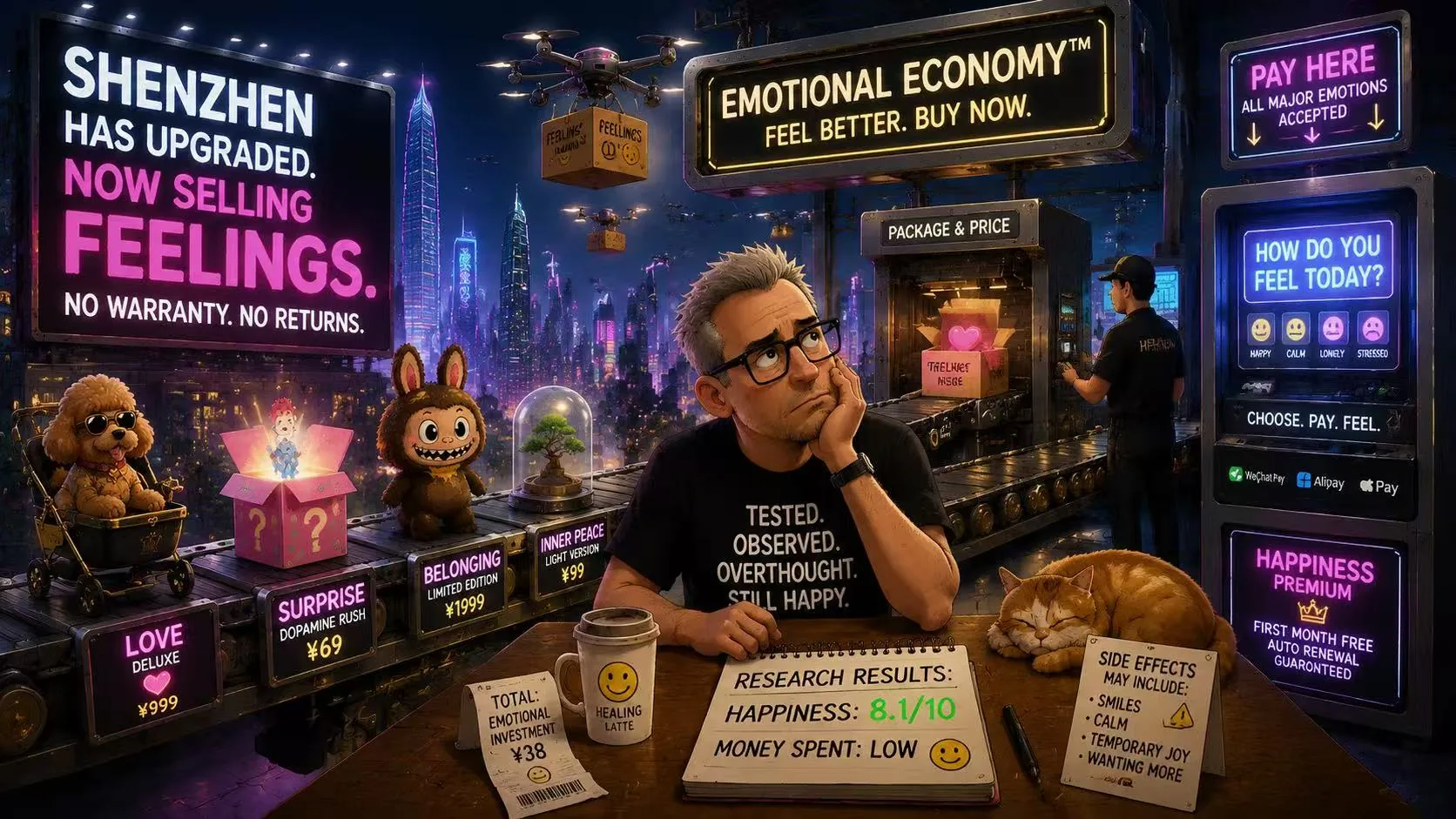
From Blind Boxes to Labubu … The Curious Business of Buying Happiness
I recently learned that apparently I have a new economic problem. My emotions have not yet been sufficiently monetized.
Think about that for a moment. I have lived in China for more than twenty years, survived financial crises, Covid, factory relocations, Chinese banks, various canteens and at least three generations of air conditioners. I considered myself emotionally more or less fully equipped.
Apparently not.
Shenzhen has discovered a new growth market: feelings. A new term has appeared in the current economic vocabulary: 情绪消费 qíng xù xiāo fèi … emotional consumption. It refers to products and experiences that do not necessarily solve a practical problem, but are supposed to give us joy, comfort, relaxation, companionship or simply a few pleasant minutes in which life does not consist entirely of passwords, meetings and wondering where the charging cable has disappeared to again.
I find this remarkable. Shenzhen used to produce things we needed. Then Shenzhen started producing things we had no idea we needed until someone produced them. Now Shenzhen apparently produces the feeling we get after buying them.
Economically, this is genius. At some point, a person owns enough televisions. But feelings? There is always room for more.
So I decided to investigate this new economy personally. Not scientifically in the strictest sense. There was no control group, no laboratory and nobody wore a white coat. But I observed, tested and afterwards assessed my emotional condition. By my standards, that is more than enough science.
Experiment Number One: Pets
Pets are, of course, part of this new emotional economy. In Shenzhen, a dog can now have clothes, special food, a birthday cake and occasionally a stroller that would have made my first car look rather poorly equipped.
We have already written extensively about this phenomenon, however, so I will not let the dog take over the entire column again. It would probably go to his head anyway.
Let me just say this: once you have seen a toy poodle in Shenzhen sitting in an air conditioned stroller while its owner walks beside it carrying the shopping bags, you begin to suspect that the traditional division of responsibilities between humans and pets may be up for renegotiation.
Emotional state: 7 out of 10. Cost: 0 RMB.
I did not buy a dog. The dog did not look particularly interested in buying me either. Moving on.
Experiment Number Two: Surprise Boxes
Much more interesting are those little boxes. Blind boxes. You buy one without knowing which figure is inside. This is often presented as a wonderfully modern consumer trend.
Unfortunately, I have some disappointing news for the younger generation.
We had this already.
It was called Kinder Surprise.
Of course I had them too. The principle was brilliant: you got chocolate together with the hope of finding some tiny plastic object that you desperately wanted, despite not knowing it existed five minutes earlier.
We did, however, have to eat the chocolate before reaching the toy.
Analogue gambling with calories.
And it had one decisive advantage: if the figure was rubbish, at least you had eaten some chocolate. Today you pay directly for the disappointment.
Otherwise, the principle is remarkably similar. Box. Suspense. Tear it open. Brief dopamine rush. “Oooohhhh!” Or: “Damn. I already have this one.” And naturally, you buy another.
Ferrero had already understood in 1974 what today requires terms such as “Emotional Consumption Experience.” Human beings love surprises. Especially surprises they have paid for themselves.
Only the target audience has changed. Back then, we were children sitting on the carpet hoping for a particular figure. Today, adults stand in designer stores doing essentially the same thing. The carpet is nicer. And the figure is more expensive.
Personally, I now prefer observing this from a safe distance. One does not have to participate personally in every experiment. I also watch skydivers without subsequently jumping out of an aircraft.
Emotional state: 7.4 out of 10. Cost: 0 RMB.
So far, the scientific work is going extremely well.
Experiment Number Three: Labubu
And that brings us, inevitably, to Labubu. If you do not know Labubu, congratulations. You have apparently spent the past two years successfully living under a rock.
Labubu is that little creature with enormous ears, a broad grin and a set of teeth that would probably make my dentist book his next holiday immediately.
And let us be fair: Labubu is hardly the beauty queen of the stuffed animal world. It looks a little as though a Gremlin, a rabbit and a bad tempered goblin had somehow produced offspring together.
Nevertheless, it hangs from handbags, sits on desks and occupies display cabinets. Celebrities carry it, adults queue for it and rare versions reach prices at which I become slightly nervous about continuing to use the word “toy.”
The really fascinating thing is not Labubu itself. It is that mysterious moment when suddenly everybody decides:
I need one too.
Why?
No idea.
That is the beauty of a trend. If you could explain it rationally, it would probably already be over.
Today Labubu, tomorrow something else. And the day after tomorrow, yesterday’s superstar sits somewhere on a shelf watching its successor being carried past.
Naturally, the market also has a solution for people who find the original too expensive: Lafufu.
That is the affectionate name commonly given to cheap or fake Labubus. Labubu for people whose emotional needs are real, but whose credit card limit also has feelings.
I almost find Lafufu more likeable.
The original says: “I belong.”
Lafufu says: “Me too … but we have to be sensible.”
Some look as though the original Labubu already had a very difficult night and the copy then went out for another one. One ear slightly higher, the teeth a little out of alignment, the expression somewhere between sleep deprivation and customs confiscation.
I bought neither Labubu nor Lafufu. I looked at them. They looked at me. We mutually agreed to go our separate ways.
Emotional state: 7.6 out of 10. Cost: 0 RMB.
I was slowly beginning to suspect that happiness might indeed be purchasable, but that I was personally too stingy to provide scientific proof.
Experiment Number Four: Healing
Then came healing. Healing cafés. Healing spaces. Healing gardens. Healing lifestyles. Everything heals.
I had no idea there was so much wrong with me.
Apparently it is no longer enough simply to sit somewhere. The place has to do something to you. A normal café sells coffee. A healing café also sells you the hope that after drinking it you will be a more balanced human being.
So I sat down. Plants. Warm light. Quiet music. Everything was so peaceful that I hardly dared put my phone on the table. It might have made the atmosphere aggressive.
I ordered something. And waited to be healed.
Next to me, someone was photographing a drink. First from above. Then from the side. Then with a hand. Then without the hand. Then by the window. After several minutes I had the distinct impression that the drink would rather be consumed, but was too polite to say anything.
I simply sat there.
And something actually happened.
No enlightenment. No sudden understanding of the universe. After about twenty minutes, I needed the bathroom.
Perhaps that was the first step.
But afterwards I sat down again and realised: this is actually quite pleasant. No email. No meeting. Nobody wanted anything from me. Just sitting there. Perhaps healing does not need a more complicated definition.
Emotional state: 8.1 out of 10. Cost: low.
At last, my research had generated some economic activity. Shenzhen could relax.
So What Have I Scientifically Proven?
Perhaps this “Emotional Economy” is not quite as ridiculous as it sounds. People do not always buy something because they need it. Sometimes they buy surprise, belonging or simply ten minutes of good mood.
Shenzhen, however, would not be Shenzhen if this did not immediately become a business model. Lonely? There is something for that. Stressed? Same. Joy? Blind box. Want to belong? Labubu. Labubu too expensive? Lafufu. Inner peace? Scan the QR code.
And with that, my scientific experiment was complete. I had bought remarkably little. No dog, no blind box, no Labubu and not even a slightly damaged Lafufu. Basically, I had only bought a drink.
Final emotional score: 8.1 out of 10. Total cost: manageable.
Perhaps that is the joke. Our desire for small moments of happiness is not new at all. In 1974, mine came inside a chocolate egg. Today it comes in a blind box, hangs as a Labubu from a handbag or waits among the houseplants in a healing café.
The product changes. The feeling, not so much.
Perhaps happiness really can be bought. I am just afraid that somewhere in Shenzhen, someone is already working on the next version:
Happiness Premium. First month free. Automatic renewal thereafter.
And damn it … I would probably click.
Chris Gassner
Keep reading
All in Articles
Legend Levels Up: Shekou's Beloved Hangout Reinvents Itself as a Sports Bar & Grill
Some bars are places you go. Legend is a place you return to. For six years, this Shekou staple has anchored the corner of Nanhai Yiku, pouring...
Free Sky Observation Deck: Shenzhen's Window to the Clouds at 547.6 Meters
High above the pulsating heart of Shenzhen, the Free Sky Observation Deck commands the 116th floor of the Ping An Finance Center at a...
China's New Kind of Pet Remembers Your Conversations, Never Needs a Vet, and Doesn't Pee on the Carpet
I once wrote about dogs in strollers in China, and after that I stopped being surprised by what comes rolling towards me in a shopping mall. Baby,...