
The Paradox of To-do Lists
By Nitya Menghani · July 30, 2026 · 4 min read · 👁 0 views
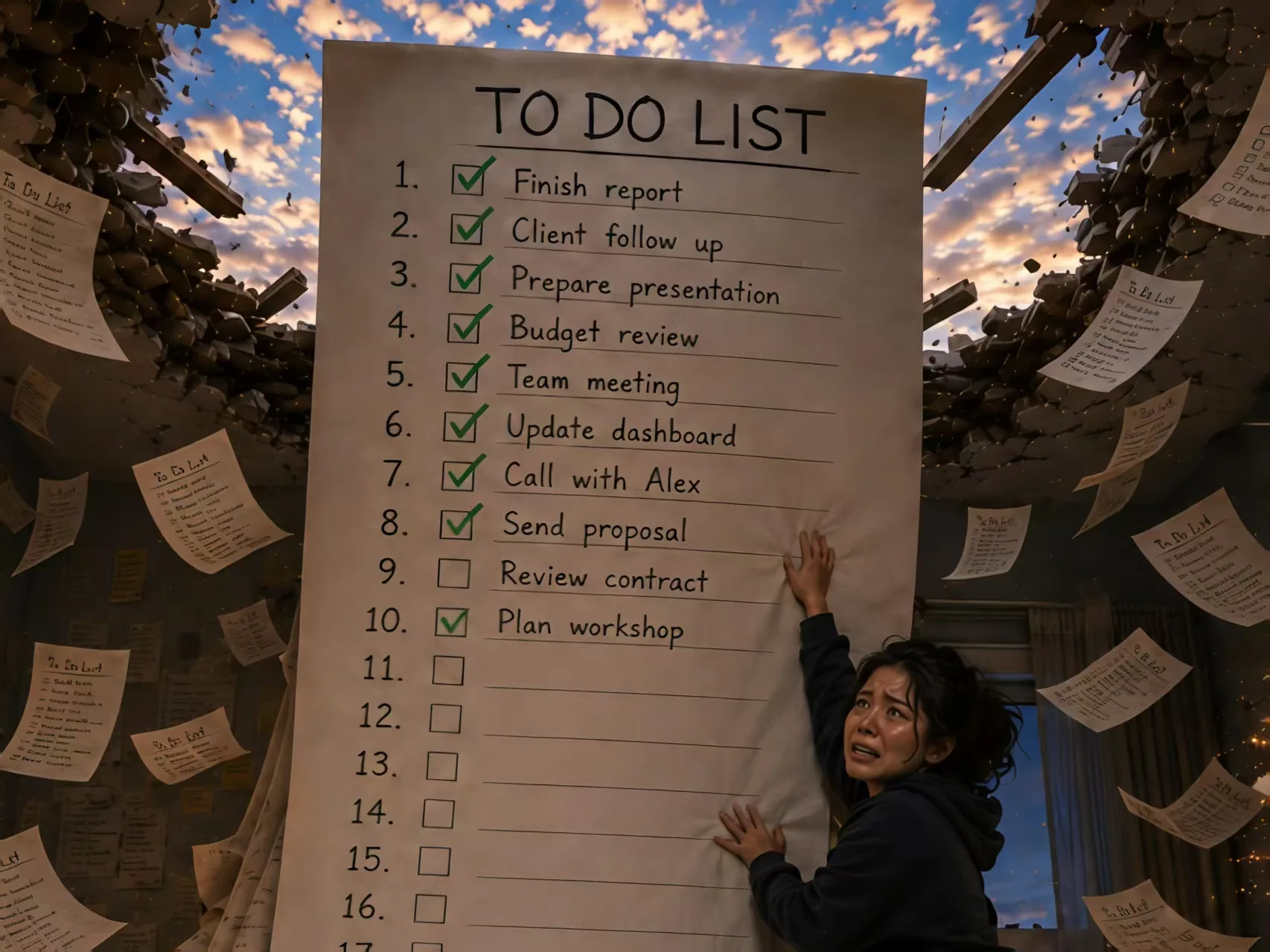
My to-do list routine doesn’t wait for mornings; it starts earlier. Before winding up at night, I sit down for 5 minutes and set the targets for the next day. Just looking at the long list of things, I already feel a sense of dread. Anxiety starts creeping in, and all I can think of at night is “How am I going to get all that done”? What’s even more frustrating is that by next day 12:00 p.m., I realize it’s already midday and I’ve only crossed off 3 things with 5 more to go. That’s not reassuring at all! On the contrary, if I don’t write my to-do list at night, I find myself panicking in my sleep, wondering if I’ll remember the things that need to be done tomorrow. The tool that’s supposed to make us feel calm and organized becomes the very source of anxiety and mental turmoil.
The first issue with to-do lists is the illusion of control. We write down tasks as a form of cognitive offloading. And yes, it helps us meet deadlines and fulfill our promises. It tells us when we’re scheduled to meet up with friends and which days are work-focused. When a new task comes up, just a glance at our to-do list can help allocate the task in such a way that the days feel well-balanced and less hectic.
But, emotionally, it manifests as an externalized trigger for anxiety. The long list and the blank boxes that need to be checked all become too much to handle. Then, even 24 hours don’t seem to be enough. Instead of being a tool, it becomes the boss. A to-do list’s purpose is to serve you, to help you manage your tasks efficiently. However, we often find it to be controlling us. The guilt we feel after failing to complete all the tasks on the to-do list is clear evidence of us serving the list, rather than the other way around.
The second issue is the psychological reaction that the visual cues of to-do lists bring. Imagine you have a list of 10 tasks: 7 done, 3 pending. What catches your eye first? Despite having most of your list crossed off, the brain focuses only on the 3 unfinished tasks. So, the visual cue of the absence of a checkmark speaks louder to us than the presence of one. Moreover, the dopamine hit that comes with checking off a box is no doubt extremely satisfying. But it only lasts a bit, then it’s back to feeling anxious about completing all the tasks.
Therefore, in spite of working hard all day, the 3 pending tasks will bring you more guilt and annoyance than the satisfaction of the 7 completed ones. This dopamine hit raises another issue with our approach towards tackling the to-do list at the start of the day. Because our brain is looking for that dopamine hit, it tends to choose the easiest tasks on the list to complete first. However, mornings are usually when we are the most energetic, so choosing an easy task to start seems counterintuitive.
Additionally, when we look at the long to-do list, we don’t consider the amount of time required for each task. It might be true that there are 8 tasks to complete today. But, half of them will probably take 20 minutes each to be checked off. In our heads though, we assume all tasks will take the same amount of time (usually 1 hour), which is why we feel lethargic even before we’ve started.
A to-do list is arguably one of the simplest yet best tools for managing our day. Yet, the daily cycle of anxiety highlights its inherent flaws. It promises clarity but delivers chaos. It assures productivity but emphasizes our inefficiency. And being told you are not doing enough every single day while you are trying your best all the time doesn’t feel good at all, does it?
About the Author
Nitya Menghani is a young Gen Z, who has lived her whole life in Shenzhen, trying to navigate through the twists and turns of a young adult life as an expat in the city. She is an aspiring businesswoman eager to create an impact and is currently pursuing a business management degree. Other than that, she has also freelanced as a social media assistant manager, sales and customer service intern, and AI marketing content creator. Her writing is inspired by the complex thoughts and conversations that stem from the ordinary moments of life. She hopes that by writing them down, she can perhaps help herself and others navigate through them too.
Nitya can be contacted via WeChat on the following QR.

Keep reading
All in Articles
Legend Levels Up: Shekou's Beloved Hangout Reinvents Itself as a Sports Bar & Grill
Some bars are places you go. Legend is a place you return to. For six years, this Shekou staple has anchored the corner of Nanhai Yiku, pouring...

Free Sky Observation Deck: Shenzhen's Window to the Clouds at 547.6 Meters
High above the pulsating heart of Shenzhen, the Free Sky Observation Deck commands the 116th floor of the Ping An Finance Center at a...

China's New Kind of Pet Remembers Your Conversations, Never Needs a Vet, and Doesn't Pee on the Carpet
I once wrote about dogs in strollers in China, and after that I stopped being surprised by what comes rolling towards me in a shopping mall. Baby,...