
The Smartphone Has Replaced the Babysitter, But at What Cost?
By Chris Gassner · August 10, 2026 · 7 min read · 👁 0 views
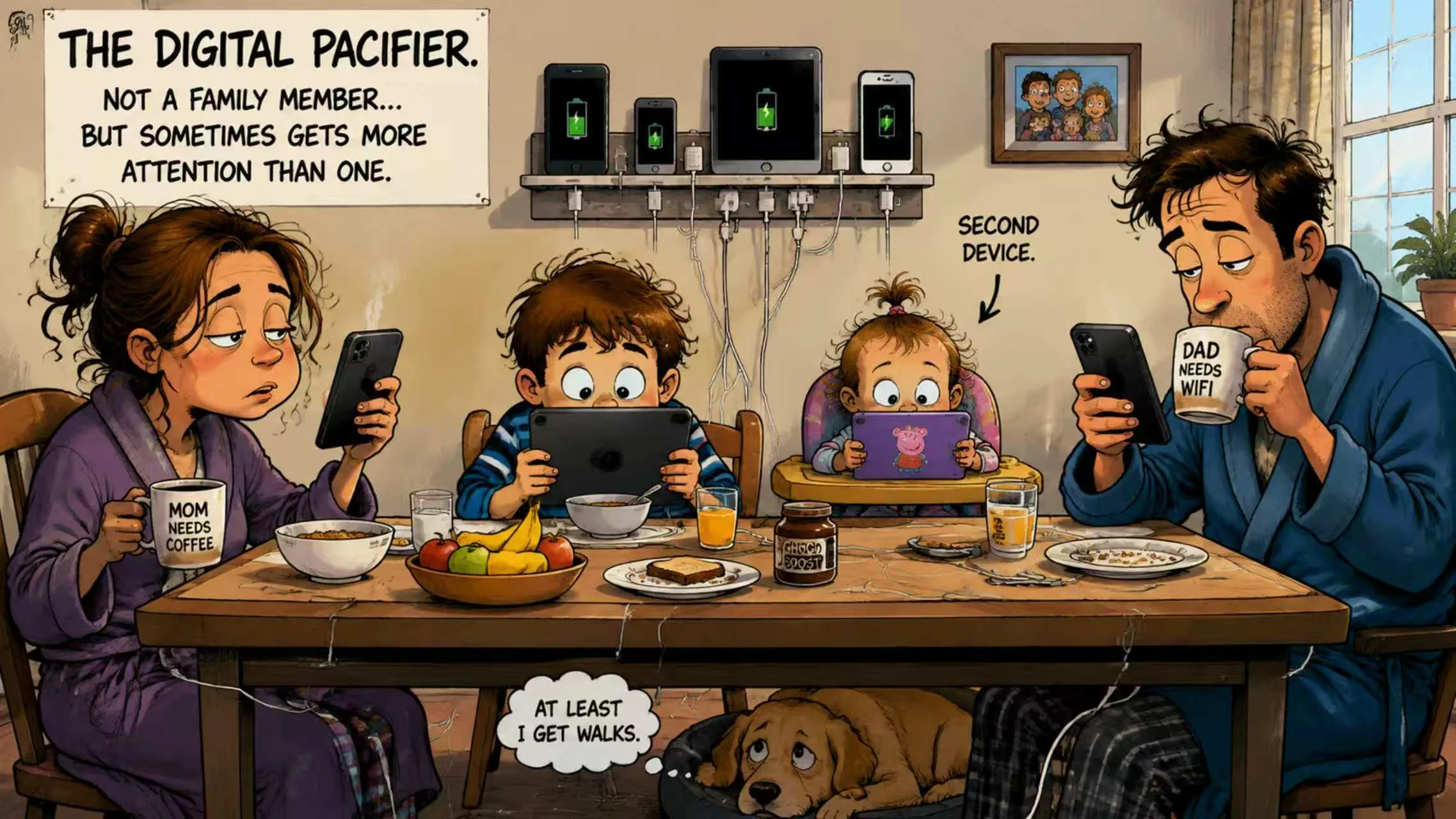
When the babysitter fits in your pocket
In the past, calming down a toddler required a pacifier. A small piece of plastic that cost five Deutschmarks and reliably collected every single piece of dust and hair from the household under the sofa.
Today, all you need is a smartphone.
It costs hundreds of euros, but in return it collects far more valuable things: locations, interests, contacts, sleeping habits, and the information that a three year old child has watched the same video of a dancing pig 47 times in a row.
The modern digital pacifier enters the scene surprisingly quickly. The child starts complaining in a restaurant: smartphone. The child gets bored in the car: smartphone. Mum wants to drink her coffee in peace: smartphone. Dad urgently needs to answer a message that ends with three laughing emojis: smartphone.
And if Mum herself is currently lost in TikTok or Douyin, the child simply gets a second device. One family, two generations, three charging cables … and finally, silence.

The phone is not only handed over when the situation has already exploded. Quite often, it is distributed as a precaution. Before the child has even had the chance to discover boredom, Peppa Pig is already armed and ready on the table.
Modern parents are faster at this than an emergency doctor with a defibrillator.
“The child might become restless!”
Boom … screen on.
And it works brilliantly. The child immediately becomes silent and stares at colourful characters moving across the screen. The adults can eat, talk, or quietly stare at their own phones.
From the outside, the family looks remarkably peaceful. So peaceful that one almost forgets that a family normally consists of human beings who make noise.
The problem is: A quiet child is not automatically a learning child.
Children have to touch the world, taste it, knock things over, and then confidently explain that it was probably already broken before they arrived.
They learn distances by walking into table corners. They discover gravity by dropping their spoon from the high chair fifteen times. And they develop social skills by testing the physical properties of a plastic sand shovel … preferably on another child’s head.
The reaction of the “test object” delivers an important lesson: Not every discovery needs to be repeated.
On a screen, these consequences are missing. A character falls off a cliff, and the game simply restarts. A video becomes boring, and you swipe to the next one. A person becomes annoying, and you block them.
Unfortunately, in real life, you cannot remove your little brother by swiping left. So far, neither Apple nor Huawei has managed to solve this problem satisfactorily.
Especially during the first years of life, language, self-control, and empathy develop through interaction with other people. A face reacts. A voice responds. A playmate cries when you hit them with a building block.
Peppa Pig, on the other hand, simply continues. She has an admirable emotional stability, but as a parenting expert she is somewhat limited.
Research has linked high levels of screen time among young children, among other things, with fewer parent-child conversations and less favourable developmental outcomes. But not every screen experience is the same.
A video call with Grandma is something completely different from ninety minutes of short videos throwing the next little sugar cube at the brain every few seconds.
Watching something age appropriate together and talking about it is different from simply putting a device on the table and withdrawing from the experience.
The important question is: What does the screen replace?
If it replaces ten minutes of waiting at the doctor’s office, human civilisation will probably survive. But if it regularly replaces conversations, free play, movement, sleep, and boredom, the helper slowly becomes a substitute.
The child gains entertainment, but loses practice time for real life.

Boredom has almost become a medical emergency today. If a child looks out of the car window for three minutes, some parents already ask with concern: “Are you okay?”
But boredom used to be an important part of childhood. It created games, ideas, and occasionally significant damage to household furniture. Not all of it was desirable, but at least it was self invented.
Digital entertainment works differently. It works like sugar. A short clip is a gummy bear for the brain: colourful, sweet, instantly available, and gone before you even have time to ask whether you wanted it.
Then comes the next one. And another one.
TikTok and Douyin, Instagram and Xiaohongshu, YouTube and Bilibili do not simply put a bag of sweets on the table. They build the entire candy factory inside the child’s room.
One piece of sugar is not a disaster. But someone who eats nothing but sweets all day will probably not be excited about broccoli in the evening.
The same can happen with fast digital stimulation. A book suddenly feels slow. A walk feels empty. And a conversation with Grandma becomes painfully badly edited.
She has no filters, takes long pauses, and tells stories that last longer than thirty seconds.
The power of the device becomes especially obvious when parents try to take it away.
In the past, the ultimate punishment was:
“You are grounded for a week!”
It was unpleasant, but at least you still had your room, your music system, and if everything else failed, the window.
Today parents say:
“I’m taking your phone away.”
And the teenager looks at them as if they have not confiscated a device, but deleted their entire existence.
Friends, music, photos, games, group chats, social recognition, and social life are all stored inside that small rectangle.
Phone grounding is the modern version of house arrest … except that the body is still free while the digital personality has been kicked out of the house.
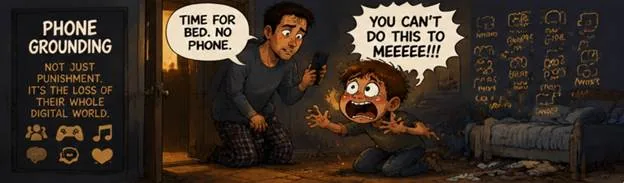
Even small children can react surprisingly strongly when the screen suddenly goes dark.
One moment the child is sitting on the sofa like a tiny monk in meditation. The next moment the living room turns into a crisis zone.
You might think you have not turned off Peppa Pig.
You have collapsed an entire infrastructure.
This does not mean smartphones are the same as alcohol, nicotine, or other substances. But many applications use similar basic principles of our reward system: novelty, surprise, and social approval.
One more clip. One more message. One more like.
Maybe the next one will be something amazing.
It is a digital slot machine … except there is no coin slot and the machine has a front camera.
And adults are obviously connected to the charger as well.
It is not very convincing to tell a child to scroll less while Mum checks WeChat or Facebook during breakfast, Dad disappears into Douyin or TikTok while walking, and both of them are editing photos for Xiaohongshu or Instagram during dinner.
The phone is no longer just a device for special occasions.
For many people, it starts the day immediately after waking up. It joins them on the toilet, walks with them to the fridge, sits beside the breakfast plate, and takes a seat at the dinner table.
It is not a member of the family …
but sometimes it receives more attention than one.
A child does not only listen to what parents say. A child watches what parents do.
And the message is clear:
The phone is supposedly not important.
It just happens to be there all the time.
That is why it is not enough to simply take devices away from children.
Anyone who wants to remove the digital pacifier has to accept that noise will return.
Children will complain, ask questions, argue, and perhaps drop a spoon on the restaurant floor.
It is annoying.
But childhood was never designed to be a wellness program for adults.
We do not have to ban children from the digital world.
That would be about as realistic as trying to teach children about electricity by sealing every power socket in the house.
In Shenzhen just as much as in Stuttgart, the goal is not to declare technology the enemy.
Children will grow up with digital devices.
The only question is whether they will eventually control the device …
or whether the device will control them.
Maybe it starts with something simple:
The phone stays in the pocket during meals. It does not sleep next to the child’s pillow at night. And adults occasionally show that a black screen is not a medical emergency requiring immediate first aid.
Because a child does not learn to swim by watching a tablet video about the breaststroke.
Otherwise we will sit at the edge of the pool, watch the child sink, and say:
“But the arm movement was explained perfectly.”
At some point, we have to remove the digital pacifier, take the child by the hand, and walk together into the real world.
There is no like button there.
But at least nobody needs a charger before giving you a hug.
Chris Gassner
Keep reading
All in Articles
Legend Levels Up: Shekou's Beloved Hangout Reinvents Itself as a Sports Bar & Grill
Some bars are places you go. Legend is a place you return to. For six years, this Shekou staple has anchored the corner of Nanhai Yiku, pouring...

Free Sky Observation Deck: Shenzhen's Window to the Clouds at 547.6 Meters
High above the pulsating heart of Shenzhen, the Free Sky Observation Deck commands the 116th floor of the Ping An Finance Center at a...
China's New Kind of Pet Remembers Your Conversations, Never Needs a Vet, and Doesn't Pee on the Carpet
I once wrote about dogs in strollers in China, and after that I stopped being surprised by what comes rolling towards me in a shopping mall. Baby,...