
Understanding Burnout Before It Takes Over
By Courtney Gumson · September 10, 2026 · 5 min read · 👁 0 views

When Rest Doesn’t Fix the Problem
It usually doesn’t start with a dramatic breakdown. Burnout rarely announces itself.
You still show up to work.
You still answer messages.
You still take care of your family.
From the outside, everything looks normal.
But inside, something has changed.
The things that used to feel easy now require enormous effort.
A simple email feels exhausting.
A small inconvenience feels overwhelming.
You find yourself becoming impatient with people you care about.
You stop looking forward to things you normally enjoy.
And then comes the confusing part:
“I’m not doing anything that different. Why do I feel like I can’t keep going?”
This is one of the reasons burnout can be difficult to recognize.
Many people expect burnout to look like quitting, collapsing, or completely falling apart.
More often, it looks like functioning while running on empty.
Burnout Is a Stress System That Has Been Overloaded Burnout develops when the demands placed on us consistently exceed the resourceswe have available.
Those demands can come from work.
But they can also come from:
-
parenting -
caregiving -
academic pressure -
relationships -
relocation -
managing life across cultures -
trying to meet everyone’s expectations
The problem is not that someone has responsibilities. Those are just part of life.
The problem happens when there is no real recovery between periods of demand.
Your brain and body are designed for cycles.
-
Focus.
-
Effort.
-
Recovery.
-
Repeat.
But many modern lifestyles create constant activation.
The workday ends, but your brain keeps planning.
The family trip begins, but you are still managing logistics.
You sit down, but your mind is reviewing everything unfinished.
Your body may be resting while your stress system is still working.
The Three Stages of Burnout
Burnout is not an on/off switch. It often builds gradually.
Stage 1: The “I can handle this” stage
This is where many high-functioning people stay for a long time.
You are capable.
You are responsible.
You solve problems.
You push through.
You might even feel proud of how much you can handle.
The problem is that pushing through becomes your main strategy.
You start ignoring early warning signs.
You sleep less.
You say yes more.
You stop doing things that refill your energy.
You tell yourself:
"Things will calm down soon."
But soon keeps moving.
Stage 2: The depletion stage
This is where your usual strategies stop working.
You might notice:
-
difficulty concentrating -
procrastinating on simple tasks -
needing more time to start things -
feeling emotionally reactive -
making more mistakes -
losing patience -
avoiding people -
feeling tired even after sleeping
A common misunderstanding:
People assume they are becoming lazy, but often, they are depleted.
When the brain has been operating under prolonged stress, executive functions like planning, prioritizing, and emotional regulation become harder.
This is why burnout can feel like:
"Why Can't I just get myself together?"
Stage 3: The shutdown stage
This is when people often finally seek help.
They may experience:
-
feeling disconnected from work or relationships -
losing interest in things they used to enjoy -
feeling hopeless about change -
strong anxiety -
physical symptoms -
difficulty functioning day-to-day
At this point, recovery usually requires more than simply taking a weekend off.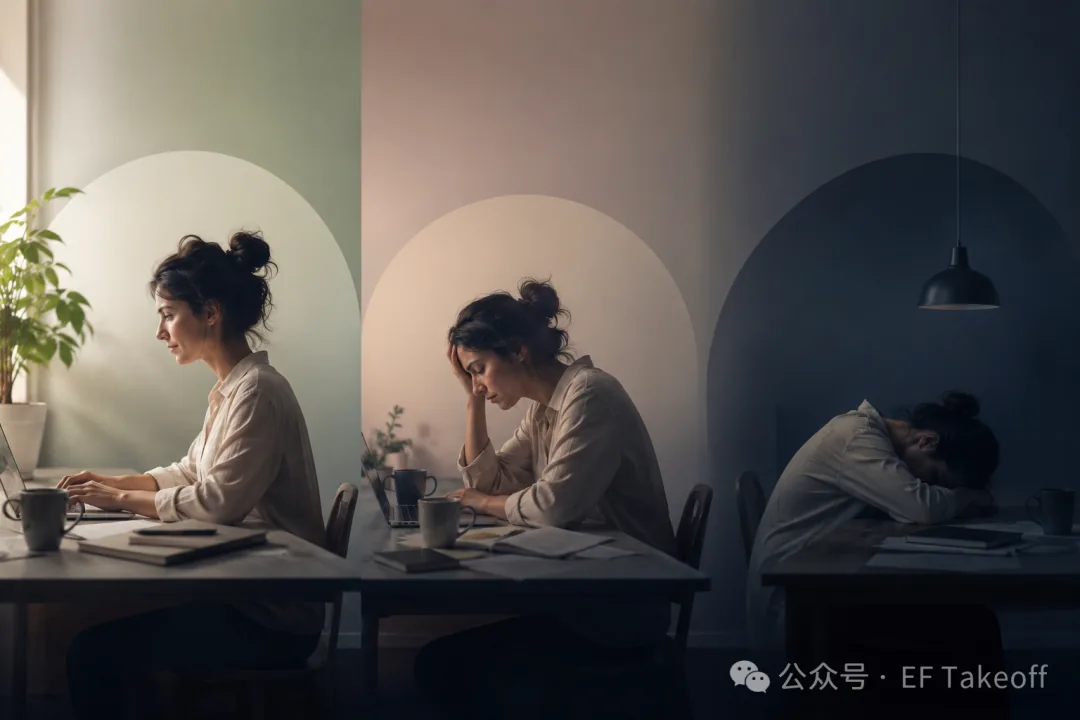
How to Recognize Burnout in Yourself
Ask yourself:
Am I tired because I did a lot, or tired because I have been carrying too much for too long?
- Normal tiredness usually improves with rest. Burnout often follows you into rest.
Other questions:
Do I feel like everything is harder than it should be?
- A task that once took 20 minutes now takes an hour. A small decision feels impossible.
Am I becoming someone I don’t recognize?
- Maybe you are more irritable, withdrawn, less patient because your system is overloaded.
Have I stopped doing things that help me feel like myself?
- Many people remove the very things that protect them like exercise, friends or hobbies because they feel like something “extra.” But those things often serve as recovery.
How to Recognize Burnout in Others
Burnout does not always look like someone asking for help.
Sometimes it looks like:
The colleague who stops contributing ideas.
The friend who keeps cancelling plans.
The parent who seems unusually impatient.
The person who says: "I'm fine," but everything about their behavior says they are struggling.
When supporting someone experiencing burnout, avoid adding pressure.
Comments like:
"You need to relax."
"Just take a vacation."
"You're working too much."
Usually come from a good place, but they do not address the actual problem.
Instead try:
I've noticed you seem like you have a lot on your plate.”
“How can I make things easier right now?”
“Do you want help thinking through what is taking the most energy?”
Recovering From Burnout: Reduce the Load Before Adding More
When people feel burnt out, they often create a huge recovery plan.
New routines.
New goals.
New habits.
But recovery requires energy, so start by reducing friction.
1. Stop treating recovery like another task to complete
A walk does not need to become a 10-step wellness routine.
A meal with a friend does not need to be optimized.
Your brain needs experiences that are not connected to performance.
2. Identify what is draining you.
Not all stress is the same.
Some stress comes from too much work.
Some comes from uncertainty.
Some comes from carrying responsibilities alone.
Some comes from never feeling finished.
The solution depends on the source.
3. Build boundaries before you feel desperate
Many people wait until they are overwhelmed before changing anything.
Boundaries work best before crisis.
Examples:
- Not answering messages immediately.
- Protecting transition time between work and home.
- Saying no before resentment builds.
- Creating realistic expectations.
- Prepare for high-demand seasons
For many Shenzhen families, August/September is a major transition.
New school year.
New routines.
New workload.
Don’t wait until everything starts.
Ask:
What usually overwhelms me?
What support can I arrange now?
What can become easier through planning?
When Is It Time to Get Support?
Everyone experiences stress.
Burnout does not mean something is wrong with you.
But support can be useful when:
-
exhaustion is affecting daily functioning -
your mood has significantly changed -
you feel stuck despite trying to make changes -
relationships are being affected -
you can't identify what needs to change -
you feel like you are constantly surviving instead of living
Sometimes an outside perspective helps you see patterns that are difficult to notice from inside the situation.
At the beginning of summer, many people imagine a reset.
A chance to recover.
A chance to finally catch up.
But recovery is not only about having more free time.
It is about understanding what your mind and body have been carrying.
Before September arrives, check your internal flight controls.
Are you preparing for the next season with more capacity?
Or are you simply hoping you can push through again?
Sometimes the most important change is not trying harder.
It is noticing what your system has been asking for.
Courtney Gumson is a Licensed Master Social Worker, Registered Counsellor and certified Executive Function coach in Shenzhen. She is the founder of EF TakeOff Coaching, offering mental health support services including counseling and executive functioning coaching. She offers free support sessions every other Tuesday at the Shekou MSCE.
Website: eftakeoffcoachingcg.com or email: [email protected]
Keep reading
All in Articles
Legend Levels Up: Shekou's Beloved Hangout Reinvents Itself as a Sports Bar & Grill
Some bars are places you go. Legend is a place you return to. For six years, this Shekou staple has anchored the corner of Nanhai Yiku, pouring...

Free Sky Observation Deck: Shenzhen's Window to the Clouds at 547.6 Meters
High above the pulsating heart of Shenzhen, the Free Sky Observation Deck commands the 116th floor of the Ping An Finance Center at a...

China's New Kind of Pet Remembers Your Conversations, Never Needs a Vet, and Doesn't Pee on the Carpet
I once wrote about dogs in strollers in China, and after that I stopped being surprised by what comes rolling towards me in a shopping mall. Baby,...