
Overnight, My Ordinary Shenzhen Intersection Became a Floral Spectacle for APEC 2026
By Chris Gassner · October 25, 2026 · 6 min read · 👁 0 views
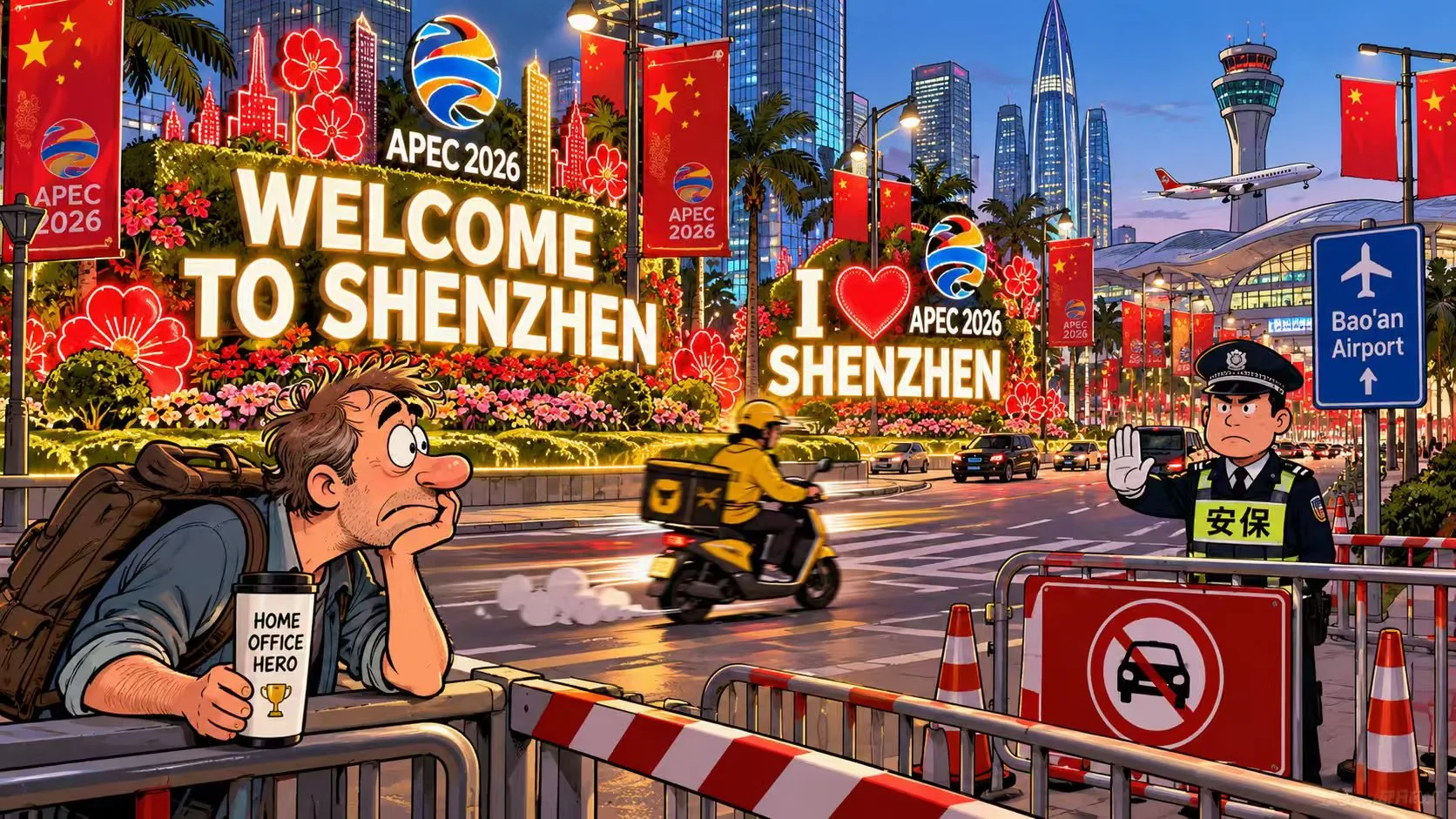
There is an intersection in Shenzhen that I have driven through every morning for the past fifteen years. A perfectly ordinary intersection. Four traffic lights, a pedestrian crossing, and at least one delivery rider on an electric scooter who runs the red light as though it were the most natural thing in the world. Perhaps he has simply lost track of which red lights still apply to him. With all the red flowers decorating the intersections these days, it's easy to get confused.
I liked that intersection. It never wanted anything from me. No attention, no QR code registration, and certainly no five-star rating in some app.
Until two weeks ago.
Someone must have decided that this particular intersection was in desperate need of a little beautification. Because practically overnight, an enormous, brightly illuminated "WELCOME TO SHENZHEN" appeared, accompanied by the APEC 2026 logo. A few streets further down, at another intersection, there is now a monumental "I LOVE SHENZHEN" sign, complete with a bright red heart. I hope it's solar-powered. Otherwise, that much love could make quite a dent in the electricity bill.
And it didn't stop there. Suddenly, flags are hanging everywhere. From lampposts, along main roads, outside public buildings. Banners, illuminated signs, elaborate flower arrangements. You drive through a perfectly normal city in the evening, and the next morning the same street looks as though every international celebrity has decided to arrive that very afternoon.
What I keep wondering is when they actually do all this. In the evening, there's nothing. By morning, half the city is covered in flowers and signs. I suspect there's an entire army of modern-day elves somewhere, except these ones don't carry little brooms. They come equipped with trucks, cranes, and several kilometres of decorative lighting.
After twenty years in Shenzhen, I'm suddenly being welcomed by my own intersection. It's rather like coming home after twenty years of marriage and finding your wife standing at the front door with a bouquet of flowers, asking whether you had any trouble finding the place.
The reason for this citywide makeover is well known. On November 18 and 19, Shenzhen will host the APEC Economic Leaders' Meeting. The Asia-Pacific Economic Cooperation brings together 21 economies, and this year Shenzhen has the honour of welcoming their leaders.
And when Shenzhen hosts something, it doesn't do things by halves. Nobody simply hangs up a flag and hopes it won't rain. Everything gets decorated, illuminated, planted, and then inspected once more to see whether there might be room for a few additional flowers.
Some traffic islands now look like Keukenhof in the Netherlands. The difference is that in Holland you have to pay admission, while in Shenzhen you can admire the entire floral extravaganza for free while waiting at a red light. Assuming, of course, you're not a delivery rider, for whom that particular colour apparently still carries no legal significance whatsoever.
The streets are getting the beauty treatment too. In Germany, when traffic signs get dirty, we simply wait for rain. At least I've never seen anyone washing a road sign in Germany. Here, I have.
And then there are those water-spraying trucks that regularly drive through Shenzhen, soaking the roads. For years, I've wondered what exactly they're supposed to achieve. Apparently, they help suppress dust, clean the streets, and cool the road surface during summer. The only problem is that in our temperatures, the water sometimes evaporates so quickly that I wonder whether the dust even noticed it was under attack.
In any case, Shenzhen is now being polished for its distinguished visitors like a Chinese wedding hotel just before the bride arrives. Everything must sparkle, every flowerpot must be in precisely the right position, and heaven help anyone who discovers a bare patch of ground.
Meanwhile, the city government has made a rather interesting request of its residents: during the summit week, everyone should try to work as flexibly as possible.
Flexible sounds wonderful. A laptop on the terrace, a cappuccino in the sunshine, and the freedom to organise your own working day. In Shenzhen, however, during APEC it mainly means spending your working day as close as possible to wherever you woke up that morning.
From November 16 to 20, companies are being encouraged to offer working from home, staggered working hours, or paid leave. Entirely voluntary, of course.
The message could be translated a little more informally: Dear citizens, we're expecting important visitors. It would be lovely if you could avoid moving around too much while they're here.
Personally, I find the idea rather appealing. Finally, an international conference where my contribution to the global economy might consist of not getting stuck in traffic every morning.
I'd quite like a certificate for that.
"For outstanding services to international cooperation through exemplary staying at home."
I do wonder how this is supposed to work for all the factories, though. A software developer might be able to work from his sofa. Shipping a pallet of electric motors through Microsoft Teams is rather more difficult. I haven't tried it yet, but I suspect the bandwidth wouldn't be sufficient.
Public transport makes the whole thing even more interesting. Shenzhen plans to introduce more than fifty new feeder routes connecting to the Metro, increase bus capacity by twenty percent, and halve public transport fares during the summit.
So now we're supposed to stay at home, while Shenzhen simultaneously puts twenty percent more buses on the road. Apparently, they've also made provisions for those who didn't quite understand the request to stay home. At least those people can now travel comfortably around the city.
But my personal favourite is another idea entirely.
Anyone who voluntarily leaves their private car at home during the summit is supposed to receive a commemorative APEC transit card with credit on it, along with a special sticker for their car.
A sticker as a reward for not driving!
I can already picture myself sitting obediently at home for five days, not moving my backside off the sofa, and sending out the yellow-clad Meituan delivery rider whenever I need food. He'll still be driving around the city, of course. Someone has to make sure my voluntary contribution to traffic reduction doesn't end in starvation.
And as a thank-you, I'll receive a sticker for my car, which I can proudly drive around displaying once I'm finally allowed to drive again.
Perhaps they should hand out medals as well. Three days without starting your engine earns bronze, five days silver. Gold goes to anyone who, by the end of summit week, can no longer remember where they parked their car.
Temporary road closures have also been announced. Exactly where and when remains to be confirmed. So we already know there will be places we might not be allowed to drive through. We just don't know where. A kind of traffic management lucky dip.
The people I envy most are those living in Bao'an, particularly near the airport. Until now, proximity to the airport was considered a selling point. In November, it could turn into a sort of real estate lottery. You own an apartment, you can see it, and with a little luck, you might even be allowed inside.
Nobody yet knows exactly which roads will be closed. Estate agents might want to start adjusting their advertisements as a precaution:
"Dream apartment in prime location. Magnificent views of your own front door. Accessibility subject to the prevailing international diplomatic climate."
The visiting dignitaries probably won't have this problem. They'll have limousines, police escorts, and clear roads. I, on the other hand, might suddenly discover that my toothbrush is living inside a security zone for which I don't have an access permit.
Then again, perhaps I'm worrying about absolutely nothing. Shenzhen has organised far more complicated things before. Why should getting its own residents home suddenly become an impossible task?
Nevertheless, I'll be stocking the fridge, cancelling my appointments, and checking the whisky supply. You never know how long international cooperation might take.
And if anyone asks whether I took part in the APEC summit, I'll say, "Of course I did. I was right in the middle of Shenzhen. It was just that Shenzhen had temporarily become rather difficult for me to reach."
Otherwise, I'll simply move in underneath that enormous "I LOVE SHENZHEN" sign. The lighting, flower arrangements, and a big red heart are already there.
Although I suspect the heart has better security clearance than I do.
Chris Gassner
Keep reading
All in News
China’s September 2026 Immigration Changes: What Foreigners and Businesses Need to Know
Website: http://www.chinahrsolutions.com Address: Suite 18A, Building C, Greenview NEO Building, 6011 Shennan Avenue, Chegong Miao, Futian, Shenzhen 深圳市福田区深南大道6011号绿景NEO大厦C栋18A Phone: (+86) 0755 8277 4248 Email: [email protected]
Opening Party: PEPPER Lounge & Club, October 1 @ 18:00 Until Late
Pepper Lounge & Club Opens Its Doors October 1 at 18:00 and It's Already Rewriting the Rules of Shenzhen Nightlife. Pepper is dual-concept...
Monkey Comedy Theater: Futian's High-Voltage Hub of Laughter and Energy
Tucked away in the beating heart of Futian District, lies a cultural powerhouse that's redefining what it means to have a good time in...