
My China Company Isn't Making Money Yet. Do I Still Need Accounting?
By Nowshenzhen · June 8, 2026 · 5 min read · 👁 0 views

Recently, I spoke with the owner of a newly established company in Shenzhen. He had registered his Chinese entity with the help of a local agency and assumed everything was taken care of. With the paperwork finalized, he turned his full attention to what he believed was most important: developing his product, building a website, meeting potential customers, and refining his market strategy.
Because the company had been legally incorporated but had not yet opened a corporate bank account or generated a single yuan of business, he naturally believed that his pre-operational status meant he had zero formal obligations or compliance requirements.
About nine months later, he secured his first major deal and prepared to run the transaction through his new corporate entity. That was when the wheels came off.
Over the previous months, he had received several SMS messages relating to his company registration. Because they were written in Chinese, he had simply ignored them, assuming they were spam or marketing materials. He had never appointed a local accounting firm to assist him, so he was entirely on his own. Now that he was finally ready to start operating, he suddenly found himself locked out of the system.
He came to us at Personal Connect for emergency assistance with his accounting, backlogged compliance matters, and support in finally opening his corporate bank account. As part of our initial review, we checked his corporate status on the national company registry system and discovered that his company had already been flagged as "abnormal" due to a total failure to submit required tax declarations during the preceding nine months.
When we explained the situation to him, his response was immediate: "But we had no transactions! Why did I have to submit tax forms for an empty company?"
The Core Friction: Business Logic vs. Chinese Regulatory Reality
To be honest, his reaction is one of the most logical questions a new business owner can ask. Most entrepreneurs do not start companies because they enjoy bookkeeping, tax filings, or corporate compliance. They start businesses because they possess deep expertise in something else. An engineer wants to build better products; a consultant wants to solve complex problems for clients; a software developer wants to build scalable technology. Their focus is naturally on customers, cash runway, and growth. Accounting is rarely what excites them.
As accountants, we understand that perspective. As business owners operating in China ourselves, we understand it even more.
The challenge is that the reality of operating a business in China is often very different from Western corporate environments. One of the most common misconceptions among both local and foreign business owners is the belief that accounting obligations only begin once a company starts generating revenue.
In reality, your compliance obligations begin the exact moment your company is legally established. In many ways, the Chinese authorities are not asking whether your company is making money yet. They are simply asking whether your company exists.
The Danger of Missing "Zero-Filings" (Ling Shenbao)
A company can have zero revenue, zero employees, and zero invoices, but because the legal entity exists in government databases, certain baseline obligations continue to run by the calendar, not by your transaction volume.
In local terms, managing an inactive or pre-revenue entity requires a formal, mandatory process known as a "Zero-Filing" (ling shenbao). This is a statutory declaration covering Value-Added Tax (VAT), Corporate Income Tax (CIT), local surtaxes, and stamp taxes.
Failing to submit these zero-filings on time isn't viewed by authorities as an innocent startup oversight. It triggers an automated compliance downward spiral:
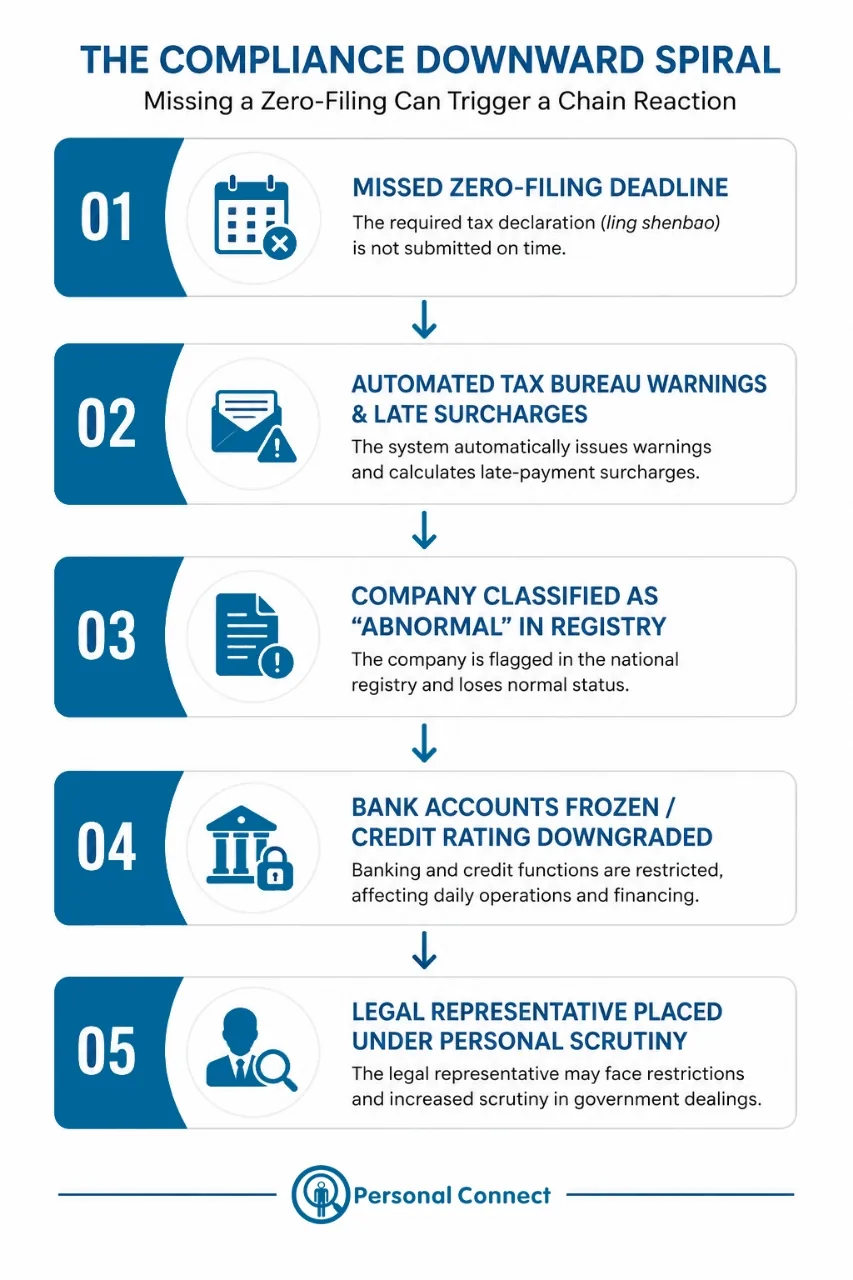 As the period of non-compliance continues, the consequences grow increasingly severe. Foreign-invested companies quickly find it impossible to make changes to company registrations, apply for operational licenses, open corporate bank accounts, or process employee visas.
Later down the road, these unresolved historical gaps will paralyze your mandatory annual audits, completely blocking your ability to legally repatriate profits back to your home country. What could have been resolved with a simple monthly declaration can easily evolve into an incredibly expensive, time-consuming compliance cleanup project.
Understanding the Government’s Perspective
To navigate China's tax ecosystem successfully, foreign founders must learn to look at their company from the government's perspective.
When an entrepreneur thinks about their startup, they think about commercial momentum. If there are no clients, they feel the business hasn't "truly" started yet. The Chinese authorities view the situation through a purely legal lens. From the moment your business license is issued, you possess a legal entity that has gained the right to conduct commercial activities and access the national tax infrastructure. Whether you choose to exercise those rights immediately is largely irrelevant to the state.
This principle of reporting inactivity isn't unique to China, but China places an exceptionally high emphasis on regular, localized administration. The government wants absolute visibility over the real-time status of all registered corporate entities within its jurisdiction.
Viewed this way, a zero-filing is not a tax payment process, it is a mandatory status report. In simple terms, a zero-filing explicitly tells the authorities: "Our company exists, we have had no taxable activity during this specific window, and we are actively maintaining our legal standing."
Prevention is Cheaper Than the Cure
In our experience at Personal Connect, very few business owners intentionally ignore their statutory obligations. Most simply misunderstand the timeline or assume that inactivity equals a free pass on paperwork.
The entrepreneur mentioned at the beginning of this article eventually resolved his compliance issues, corrected his missed historical filings, and was able to move forward with his product launch. However, what should have been a background compliance routine became a stressful, multi-month hurdle that delayed his operational launch, cost unexpected penalty fees, and stalled his first contract.
The ultimate lesson here is that the Chinese regulatory system assumes every registered corporate entity has responsibilities from Day One. Staying compliant from the very beginning is universally easier, cheaper, and faster than trying to retroactively fix systemic accounting errors months down the line.
At Personal Connect, we handle these conversations with startup founders, consultants, traders, and foreign investors every single week. As a foreign-owned firm operating locally in China, we know how overwhelming these bilingual tax dynamics can look from the outside. Our role is to step in as your local compliance anchor taking care of the mandatory CAS ledgers, e-tax integrations, and monthly zero filings so that you can keep your focus entirely on building your business.
The defining question for your early-stage startup is not whether your company is making money yet. The question is whether your company exists. In the eyes of the tax bureau, that is the only metric that matters.
About the Author
Eddie B is the founder of Personal Connect, a foreign-owned HR, accounting, payroll, and corporate services firm based in Shenzhen, China. Having lived and operated businesses in China for around two decades, he regularly advises foreign investors and SMEs on compliance, recruitment, accounting, and business operations.
Website: http://www.chinahrsolutions.com
Address: Suite 18A, Building C, Greenview NEO Building, 6011 Shennan Avenue, Chegong Miao, Futian, Shenzhen
深圳市福田区深南大道6011号绿景NEO大厦C栋18A
Phone: (+86) 0755 8277 4248
Email: [email protected]
Keep reading
All in Articles
Ours Dim Sum Rave: Where Dim Sum Met the Dance Floor
Ours has done it again, this time, dropping electronic beats right into the heart of a tea house steeped in the nostalgic charm of 20th-century Hong...

Legend Levels Up: Shekou's Beloved Hangout Reinvents Itself as a Sports Bar & Grill
Some bars are places you go. Legend is a place you return to. For six years, this Shekou staple has anchored the corner of Nanhai Yiku, pouring...

Free Sky Observation Deck: Shenzhen's Window to the Clouds at 547.6 Meters
High above the pulsating heart of Shenzhen, the Free Sky Observation Deck commands the 116th floor of the Ping An Finance Center at a...