
The Chinese Traffic Symphony
By Nowshenzhen · August 31, 2025 · 4 min read · 👁 1,237 views
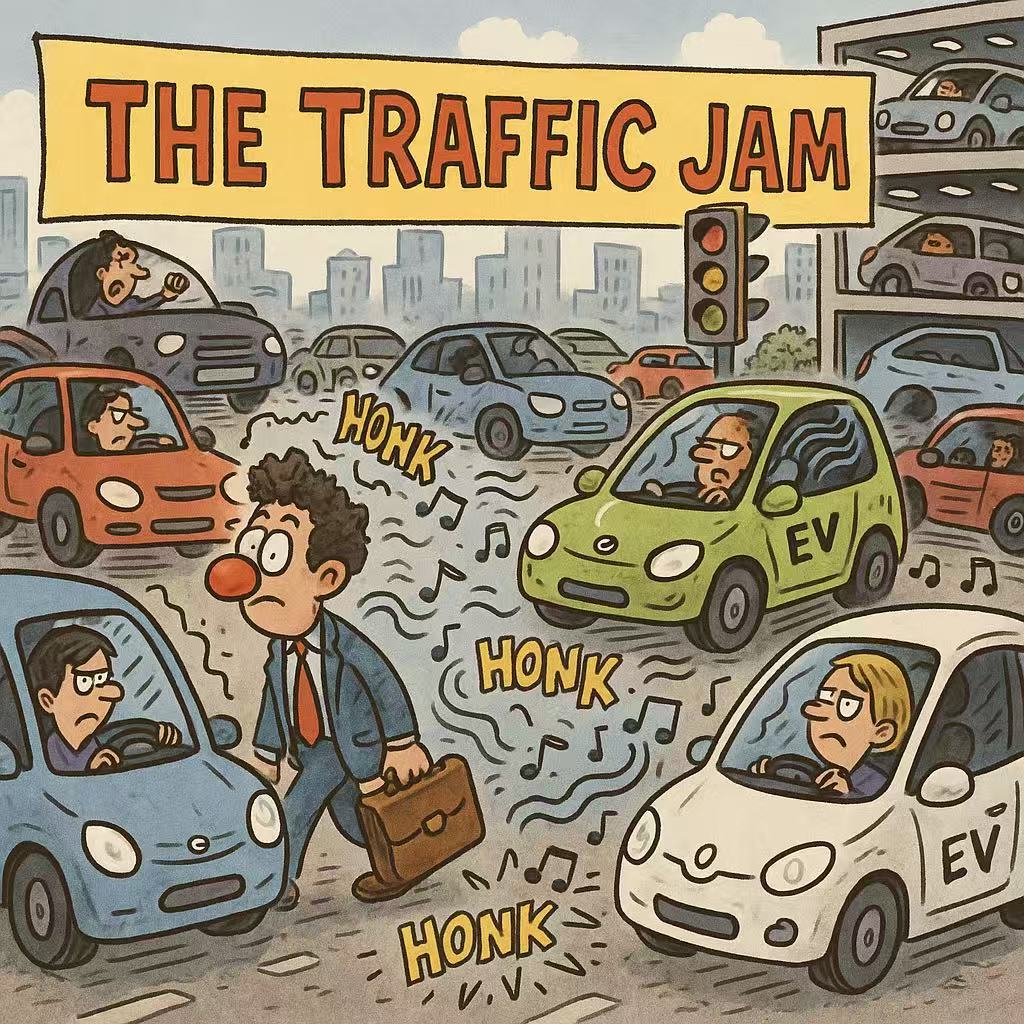
Traffic jam in China is not just “traffic jam.” It is Wagner on wheels, an endless overture of horns, smoke, misplaced optimism — and now, of course, the humming of batteries. In Europe you complain when a light is red for one minute. In a Chinese megacity the lights are red so long you could knit a sweater, learn Cantonese, and still have time to reconsider your life choices before it flips to green for exactly 17 seconds.
But green doesn’t mean go. Green means: if you feel like it, maybe consider moving, but no pressure. One car rolls, two cars roll, the third driver is still philosophically debating whether his destiny should involve this intersection. Meanwhile the rest of us watch the light turn back to red, and we wait again. Not one round, not two rounds. Sometimes four rounds before you finally creep across the intersection like a condemned man walking to the gallows.
Your GPS, in its innocence, says: Estimated arrival: 1 hour 22 minutes. What it doesn’t calculate: the 40 traffic lights in front of you, each with the patience of a Buddhist monk and the efficiency of a broken sundial. The result? You arrive tomorrow.
And when traffic finally flows, it flows at the speed of frozen honey. Forty degrees outside, asphalt glowing like an oven, and still everyone drives as though the road were covered in black ice. Every car becomes a cautious snowplow.
And then, the soundtrack. Once upon a time: horns blaring, diesel growling, exhaust smoke choking the air. Now? A new symphony. Battery cars. EVs. They whisper through the jam like UFOs in slow motion. But because they are too quiet, they’ve been given artificial voices — safety sounds so pedestrians don’t die of surprise. And so the jam becomes an intergalactic opera: one car humming like a spaceship about to abduct cattle, another wheezing like a broken washing machine, a third producing a sci-fi whine straight out of a 1970s B-movie. Twenty lanes of UFOs, each buzzing in its own pitch, and together it’s less traffic jam, more alien landing. Close your eyes and you don’t hear cars — you expect green men in silver suits stepping out to demand your toll ticket.
And just when you think you’ve reached peak madness, there’s the passenger. The living commentary system sitting right beside you. “Drive carefully! Do you want to kill me? Oh my God! Watch out! Never again with you!” Every bump becomes a Greek tragedy, every lane change a near-death experience. And then the grand finale, the mantra, the death sentence for your nerves: “That’s it. That’s it. Never again. That’s it.” Over and over, like a chorus from hell, drilled straight into your skull while the UFO-choir hums outside.
And that’s the point when you realize: there is no joy left, not outside in traffic, not inside beside you. Nervous energy builds up, your body searches for distraction. You bite your fingernails like a five-year-old, pull at your hair, dig in your ear, maybe even clip a toenail if you dare. Anything to keep yourself from exploding. And of course the voice beside you notices, never missing a chance: “Seriously? Biting your nails? Are you five? My God, man.” And then you’re not only stuck in traffic, you’re trapped in shame-management, multitasking between the jam, the alien orchestra, and your personal critic-in-residence.
And when the UFO-choir finally releases you onto the highway, mathematics dies again. Four lanes shrink to two, five become three, or — most absurd of all — four explode into twenty at a toll plaza. Not to move faster, no. Just to corral people like confused penguins into separate lines: cash, card, electronic tag. No one in the right place. The cash guy in the digital lane, the digital guy still digging for coins, and sideways migrations across twenty lanes as if penguins suddenly learned the cha-cha.
But the final level of absurdity, the final boss of traffic, is the parking garage. Outside: rules, lines, lights. Inside: anarchy. The moment you cross the threshold, all laws of traffic collapse like a dying star. The traffic rules evaporate into mist. People drive against arrows, cut across levels, wedge their SUVs diagonally into spots designed for bicycles. The UFO-choir follows you inside, so while you search for a space you’re serenaded by twenty electric cars making extraterrestrial noises, echoing through concrete walls like an alien choir rehearsal. One sounds like a spaceship preparing for warp, another like a retro arcade, a third like an electric toothbrush with ambitions.
And then comes the climax: the exit gate. No tickets anymore, everything digital. Sounds modern, sounds easy. But half the drivers scan their code when they enter, half when they leave, and the other half only start digging for their phones once the barrier is already in front of their hood. So, at the exact point where order is most needed, it collapses. Cars stand crosswise, three lanes merge into one, someone scrolls through the wrong wallet app, another remembers his phone is in the trunk, and the rest are honking while the UFO-orchestra reaches a cosmic crescendo.
It is not a parking garage. It is the Bermuda Triangle of motor vehicles. Cars go in, patience evaporates, and when — if — you finally crawl out again, you realize: this wasn’t traffic. This was evolution in reverse.
Keep reading
All in Articles
Ours Dim Sum Rave: Where Dim Sum Met the Dance Floor
Ours has done it again, this time, dropping electronic beats right into the heart of a tea house steeped in the nostalgic charm of 20th-century Hong...
Legend Levels Up: Shekou's Beloved Hangout Reinvents Itself as a Sports Bar & Grill
Some bars are places you go. Legend is a place you return to. For six years, this Shekou staple has anchored the corner of Nanhai Yiku, pouring...
Free Sky Observation Deck: Shenzhen's Window to the Clouds at 547.6 Meters
High above the pulsating heart of Shenzhen, the Free Sky Observation Deck commands the 116th floor of the Ping An Finance Center at a...